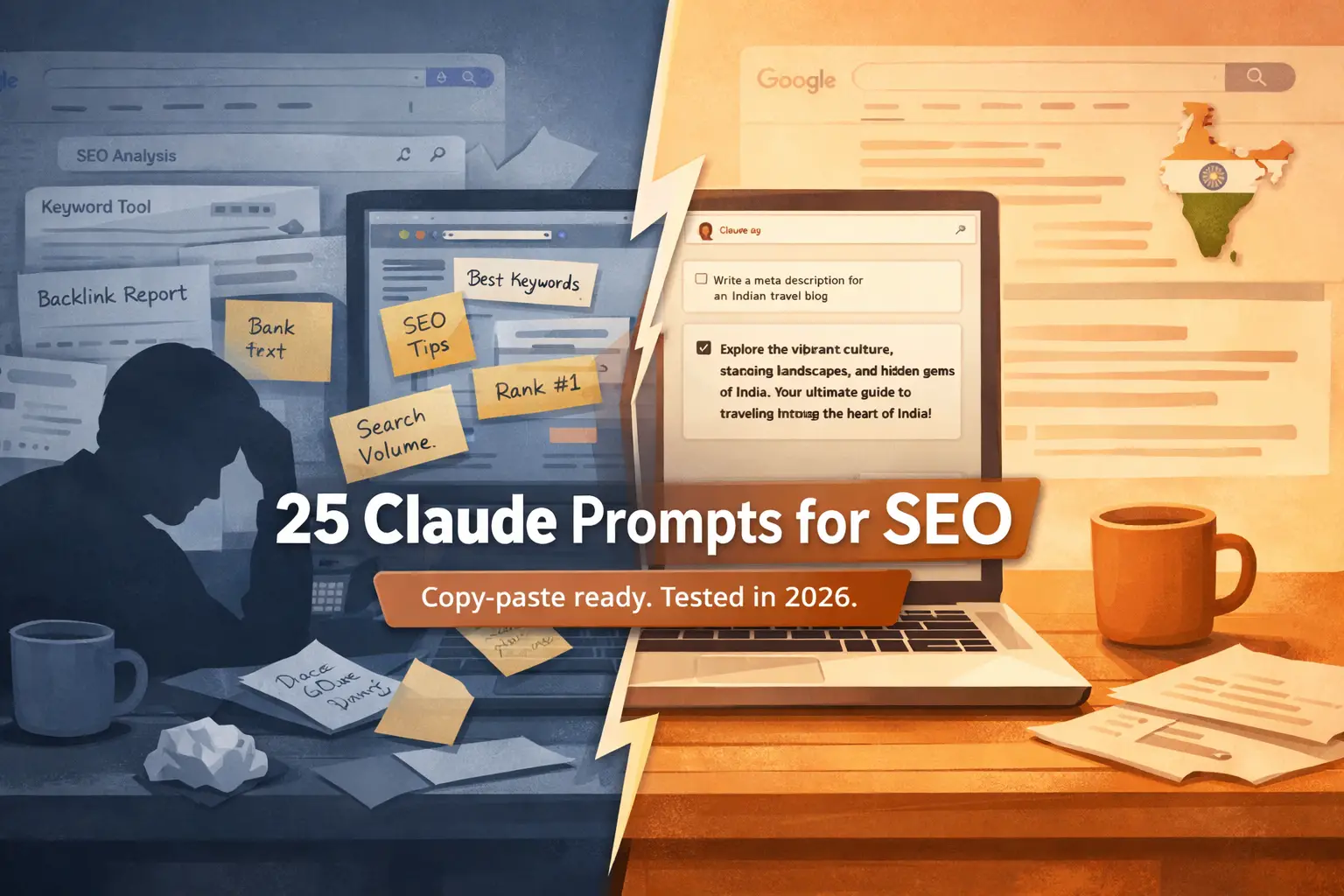
If you’ve searched for “Claude prompts for SEO,” you’ve probably found the same article twenty times — a numbered list of generic prompts that work the same in ChatGPT, Gemini, or any other LLM. This is not that article.
These 25 prompts are built specifically around what Claude does better than other models: A 200K token context window that swallows entire SERPs, Projects that remember your brand voice across sessions, Artifacts that render schema and meta previews live, and Claude Code for agentic SEO workflows. Every prompt below has been tested, and I’ve flagged where each one beats a generic approach.
Whether you’re running SEO for a D2C brand in Bengaluru, a SaaS company targeting the US market, or local service business in Mumbai, Startups in Bangalore, you can paste these directly into Claude and get output you can actually ship.
Why Claude Beats ChatGPT for SEO Work
Before the prompts, a quick reality check on why this matters.
Most LLM SEO prompts you find online are written for ChatGPT and then search-and-replaced with “Claude.” That’s wasted potential. Claude has four capabilities that specifically help SEO workflows:
Long context window. You can paste the full HTML or text of the top 10 ranking articles for your target keyword into a single message and ask Claude to analyze all of them together. ChatGPT’s smaller context window forces you to chunk this work.
Projects with persistent knowledge. For agency work or multi-client SEO, you can create a Project per client, upload their brand guidelines, sitemap, and keyword targets once, and every prompt in that Project inherits the context automatically.
Artifacts. Claude can render JSON-LD schema, HTML title tag previews, and content briefs as live artifacts you can copy directly into your CMS or schema validator.
Claude Code. For technical SEO, Claude Code can crawl folders of markdown files, rewrite meta tags in bulk, generate sitemaps, and run audits agentically from your terminal.
Keep these in mind as you read through the prompts. The best ones explicitly lean on these features.
How to Use These Prompts (The 3 Rules)
Before you copy-paste anything, three rules that will double the quality of every output:
Rule 1: Replace every bracket. Every [like this] in the prompts below is a placeholder. Don’t leave them in. Claude will follow instructions literally, and a prompt with unfilled brackets produces unfilled output.
Rule 2: Paste real data, not descriptions. When a prompt says “paste the top 5 ranking articles,” actually paste them — full text, not just URLs or summaries. Claude’s long context is the whole point.
Rule 3: Push back on the first output. The first response is almost never the best. Follow up with “make this more specific to [industry]” or “rewrite assuming the reader is a technical decision-maker” or “this sounds AI-generated, make it sound like a human who has actually done this work.” Claude’s second and third drafts are usually where the gold is.
Keyword Research Prompts
1. Multi-Intent Keyword Generator
Act as an SEO strategist with 10 years of experience in the [industry] niche.
Generate a list of 40 keywords for a website targeting [target audience] in
[country]. Organize the list into four columns:
1. Keyword
2. Search intent (informational / navigational / commercial / transactional)
3. Estimated difficulty (low / medium / high) based on typical SERP competition
4. Content format best suited (blog post, landing page, comparison, tool, video)
Include a mix of head terms, mid-tail keywords, and long-tail questions.
Prioritize keywords with clear commercial or transactional intent at the top.
Why it works: Most generic keyword prompts return a flat list. This one forces intent classification and content-format matching in a single pass, which is normally two separate steps.
2. Long-Context SERP Competitor Analysis
I’m going to paste the full content of the top 5 ranking articles for the
keyword “[your keyword]” below. Analyze all five together and give me:
1. The topics every article covers (the “table stakes”)
2. Topics that only 1 or 2 articles cover (the “differentiation opportunities”)
3. Topics that no article covers but should, based on the search intent
4. The average word count
5. The average number of H2s and H3s
6. Tone and reading level across the articles
7. The 3 biggest weaknesses I could exploit to rank higher
Article 1: [paste full text]
Article 2: [paste full text]
Article 3: [paste full text]
Article 4: [paste full text]
Article 5: [paste full text]
Why it works: This is the prompt ChatGPT genuinely can’t run well. Paste five full articles and Claude will hold all of them in context simultaneously, giving you a cross-article analysis no single-article prompt can match.
3. People Also Ask Mining
Here are the “People Also Ask” questions Google is showing for the keyword
“[your keyword]”:
[paste the PAA questions]
For each question:
1. Classify the search intent
2. Suggest a 40-60 word direct answer optimized to win the PAA box
3. Tell me which H2 in my article this should live under
4. Flag any questions where the answer requires a table, list, or
step-by-step format to win the featured snippet
My planned article outline is:
[paste your H2s]
4. Keyword Clustering for Topic Authority
I have a list of 100 keywords I want to rank for. Cluster them into topic
groups where each cluster can become a pillar page with supporting cluster
content. For each cluster, give me:
1. The suggested pillar page title and target keyword
2. 5-10 supporting article ideas with their target keywords
3. Internal linking structure (which supporting articles link to which)
4. Priority ranking based on commercial intent and ease of ranking
Keywords:
[paste your 100 keywords]
5. Competitor Keyword Gap (Using Projects)
I’ve uploaded my sitemap.xml and my top 3 competitors’ sitemaps to this
Project. Analyze the URL patterns and infer:
1. Topics my competitors cover that I don’t
2. Content types they publish that I’m missing (comparison pages, glossaries,
calculators, templates)
3. A prioritized list of 20 content gaps I should fill, ranked by likely
commercial impact
For each gap, tell me the target keyword, the suggested URL structure, and
the competitor that’s currently winning it.
Why it works: This leverages Claude Projects. Upload the sitemaps once and this prompt works across every future chat in that Project without re-uploading.
Content Brief and Outline Prompts
6. The Complete Content Brief Generator
Create a detailed content brief for an article targeting the keyword
“[keyword]”. The brief should include:
1. Suggested H1 (3 variations, all under 60 characters)
2. Meta title (3 variations, all under 58 characters)
3. Meta description (2 variations, all under 155 characters)
4. Target word count based on SERP average
5. Primary search intent and secondary intents
6. Full H2/H3 outline with a 1-sentence description of what each section covers
7. Target audience persona (1 paragraph)
8. 10 semantic keywords and entities to include naturally
9. 5 questions the article must answer
10. 3 internal linking opportunities (describe what kind of page to link to)
11. E-E-A-T signals to include (credentials, data sources, case studies)
Industry: [your industry]
Target audience: [description]
Country: [country]
7. Outline Builder with Real Competitor Input
I’m writing an article targeting “[keyword]”. Here are the H2 structures
of the top 5 ranking articles:
Article 1 H2s: [paste]
Article 2 H2s: [paste]
Article 3 H2s: [paste]
Article 4 H2s: [paste]
Article 5 H2s: [paste]
Build me an outline that:
1. Covers every topic that appears in 3+ articles (table stakes)
2. Adds 2-3 sections none of them cover (differentiation)
3. Reorders sections to match logical user journey, not competitor order
4. Flags which sections should target featured snippets
5. Suggests where to embed original data, case studies, or expert quotes
8. Featured Snippet Targeting
My article targets “[keyword]”. Google currently shows a [paragraph / list /
table] featured snippet for this query. The current snippet is:
[paste the current snippet]
Rewrite the section of my article that should win this snippet. Requirements:
1. Direct answer in the first 40-60 words
2. Format matches the current snippet type (paragraph/list/table)
3. Includes the exact question phrasing as an H2 or H3
4. Uses the target keyword in the first sentence
5. Provides enough depth after the direct answer that readers stay on page
9. E-E-A-T Enhancement Audit
Here is my draft article about [topic]:
[paste draft]
Review it against Google’s E-E-A-T guidelines and give me specific, actionable
recommendations to improve:
1. Experience signals: Where can I add first-hand examples, screenshots, or
case studies?
2. Expertise signals: Where should I cite credentials, research, or expert
sources?
3. Authoritativeness signals: What external sources should I link to, and
what would make other sites want to cite this article?
4. Trustworthiness signals: Where do I need disclaimers, data sources, or
last-updated dates?
For each recommendation, quote the exact paragraph that needs the change and
suggest the specific addition.
On-Page SEO Prompts
10. Title Tag A/B Generator with CTR Heuristics
Generate 10 title tag variations for my page about [topic], target keyword
“[keyword]”. Requirements:
– All under 58 characters (to avoid truncation)
– Include the target keyword
– Mix of formats: 3 with numbers, 3 with year, 2 with brackets/pipes,
2 with emotional hooks
– Rank them from highest to lowest likely CTR
– For each, explain in one line WHY you ranked it there
Also flag any that might trigger Google to rewrite the title in SERPs.
11. Meta Description Generator
Write 5 meta description variations for a page targeting “[keyword]”. For
each one:
– Under 155 characters
– Include the keyword naturally in the first half
– Include a clear value proposition
– End with an implicit or explicit CTA
– Match search intent ([commercial/informational/transactional])
Label each variation with the emotional appeal it uses (urgency, curiosity,
authority, specificity, social proof).
12. Schema Markup Generator (as Artifact)
Generate JSON-LD schema markup for the following article. Render it as an
artifact I can copy directly into my CMS.
Article type: [BlogPosting / HowTo / FAQPage / Product / Review]
Title: [title]
Author: [name, credentials]
Published date: [date]
Modified date: [date]
Main image URL: [url]
Article body summary: [2-3 sentences]
Key FAQs to include: [list 5-10 Q&A pairs]
Publisher: [org name, logo URL]
Include all required and recommended fields per schema.org specifications.
Why it works: Asking Claude to render the schema as an artifact gives you a live, copy-paste-ready block instead of inline code you have to extract.
13. Internal Linking Opportunity Finder
I’m going to paste my sitemap (URLs with titles) and a new article I’m about
to publish. Find 8-12 internal linking opportunities:
1. Places in the new article where I should link OUT to existing pages
2. Existing pages that should be updated to link IN to this new article
3. For each opportunity, suggest the exact anchor text (keyword-rich but
natural)
4. Prioritize links that pass authority to commercially valuable pages
Sitemap:
[paste URL + title list]
New article:
[paste full draft]
14. Anchor Text Diversity Audit
Here are all the internal links pointing to my page “[target URL]”:
[paste anchor text list]
Analyze the anchor text distribution and tell me:
1. Am I over-optimized on exact-match anchors? (risk of spam signals)
2. What’s my branded vs keyword vs generic vs URL split?
3. What anchor text variations should I add to look more natural?
4. Which existing anchors should I change, and to what?
Target keyword for this page: [keyword]
Technical SEO Prompts
15. Core Web Vitals Diagnostic
Here is a PageSpeed Insights report for my page [URL]:
[paste the full report or the Core Web Vitals section]
Give me:
1. A plain-English explanation of what’s failing and why
2. Prioritized fixes, ordered by impact-to-effort ratio
3. For each fix, the specific file types or elements that need changing
4. Which fixes I can do myself vs which need a developer
5. Expected LCP/INP/CLS improvement for each fix
Assume I’m on [WordPress / Shopify / Next.js / other].
16. Robots.txt and Crawl Budget Audit
Here’s my current robots.txt:
[paste robots.txt]
And here are the URL patterns on my site that are getting indexed but
shouldn’t be (from Google Search Console):
[paste URL patterns]
Review and suggest:
1. Specific robots.txt rules to add or change
2. Which URLs should use noindex instead of robots.txt
3. Any crawl budget waste I should fix
4. Canonical tag recommendations for duplicate content patterns
Site type: [ecommerce / blog / SaaS / directory]
17. Log File Insight Prompt (Claude Code)
I have a server log file at ./logs/access.log. Write a Python script that:
1. Extracts all Googlebot user agent hits
2. Groups them by URL path
3. Counts crawl frequency per URL
4. Flags URLs that are crawled often but return 404 or 301
5. Flags URLs in my sitemap that Googlebot hasn’t visited in 30 days
6. Outputs a CSV with the results
Then run the script and summarize the top 5 crawl budget issues you find.
Why it works: This is a Claude Code prompt, not a chat prompt. Claude Code can actually execute the script and return real findings, not hypothetical ones.
18. Bulk Meta Tag Rewriter (Claude Code)
In the ./content directory, there are 80 markdown files, each with frontmatter
including `title` and `description` fields. For each file:
1. Read the current title and description
2. Read the article body to understand the content
3. Rewrite the title to be under 58 characters, include the main keyword,
and be compelling
4. Rewrite the description to be under 155 characters with a clear CTA
5. Update the frontmatter in place
6. Output a summary table showing old vs new for every file
Preserve all other frontmatter fields exactly.
Content Refresh and Optimization Prompts
19. Decay Audit
My article [URL] used to rank in the top 5 for “[keyword]” but has now
dropped to position [X]. Here’s the current article:
[paste article]
And here are the top 3 articles currently outranking it:
Article 1: [paste]
Article 2: [paste]
Article 3: [paste]
Give me a specific refresh plan:
1. Topics the new top rankers cover that my article doesn’t
2. Outdated information in my article (stats, tool names, dates)
3. Structural changes (new H2s to add, existing ones to reorder or delete)
4. Word count gap to close
5. New internal/external links to add
6. Updated meta title and description
7. Prioritized task list in order of likely ranking impact
20. AI Overview and GEO Optimization
My article targets “[keyword]”. Google is now showing an AI Overview for
this query, and I want my article cited in it. Here’s my article:
[paste article]
Rewrite the sections most likely to be pulled into an AI Overview citation.
Requirements:
1. Self-contained paragraphs that make sense without surrounding context
2. Clear factual claims with specific numbers, dates, or names
3. Direct answers to questions, not throat-clearing intros
4. Structured data where possible (lists, comparison tables)
5. Unique information an LLM couldn’t generate from general knowledge alone
Flag the top 5 paragraphs most likely to be cited and explain why.
21. Humanize the AI-Sounding Draft
Here is a draft that sounds too AI-generated:
[paste draft]
Rewrite it so it sounds like a human who has actually done this work. Rules:
1. Kill every instance of “In today’s fast-paced world,” “It’s important to
note,” “Let’s dive in,” and similar filler
2. Replace passive voice with active where possible
3. Add specific numbers, tool names, and concrete examples instead of
abstractions
4. Vary sentence length (some very short, some longer)
5. Include at least 2 moments of genuine opinion or pushback
6. Remove any sentence that could apply to any topic
Keep the same structure, word count, and SEO keywords. Just make it sound
human.
22. Content Cannibalization Check
I have these articles on my site that all touch on “[topic]”:
URL 1: [url] — Current target keyword: [keyword], Current rank: [position]
URL 2: [url] — Current target keyword: [keyword], Current rank: [position]
URL 3: [url] — Current target keyword: [keyword], Current rank: [position]
Analyze whether these articles are cannibalizing each other and recommend:
1. Should any be merged? Which into which?
2. Should any be deleted and 301 redirected?
3. Should the keyword targeting be re-differentiated?
4. What’s the ideal information architecture for this topic cluster?
Give me a specific action plan with the exact 301 redirects and content
changes.
Local SEO Prompts for Indian Businesses
23. Google Business Profile Post Generator
Generate 10 Google Business Profile posts for my [business type] located in
[city], India. Requirements:
– Mix of post types: offer, event, what’s new, product
– Each under 1,500 characters
– Include a clear CTA
– Natural mention of [city] and relevant neighborhood names
– 2 posts should reference Indian festivals or seasonal moments
(Diwali, Holi, monsoon, etc.) appropriate for the current month
– 2 posts should highlight customer testimonials or reviews
Business details:
– Name: [business name]
– Services: [list]
– USP: [your differentiator]
– Target customer: [description]
24. Location Landing Page for Indian Cities
Create a location landing page for my [service] in [Indian city], targeting
the keyword “[service] in [city]”. The page should include:
1. H1 optimized for the target keyword
2. 150-word intro that mentions specific neighborhoods or landmarks
3. Service details section tailored to local context
4. A section addressing India-specific concerns (GST, payment modes like UPI,
language preferences, local regulations)
5. Local testimonial placeholders
6. FAQ section with 6 questions actual local customers would ask
7. Schema markup for LocalBusiness (render as artifact)
8. Meta title and description
Neighborhoods to reference: [list 5-8 neighborhoods]
Landmarks to reference: [list 3-5 landmarks]
25. Hinglish Content Considerations
I’m writing content for [topic] targeting Indian readers who consume content
in a mix of English and Hindi (Hinglish). Give me:
1. 10 naturally Hinglish headlines that would outperform pure English
2. Guidelines on when to use Hindi words in English sentences vs when to keep
it fully English
3. Common Hinglish SEO keywords for [industry] that people actually search
4. Cultural references and examples that resonate with Indian readers
5. Tone adjustments for Indian audiences vs Western audiences
Target audience: [Tier 1 cities / Tier 2 cities / pan-India]
Industry: [industry]
What Claude Still Can’t Do
I’m not going to sell you the fantasy that Claude replaces an SEO specialist. Here’s where these prompts hit a wall:
Original data. Claude can’t run a survey, scrape rankings at scale, or produce proprietary benchmarks. Original research is still the single most powerful thing you can add to a piece of content, and it has to come from you.
Verifying claims. Claude will occasionally hallucinate a statistic or attribute a quote to the wrong person. Every factual claim in a Claude draft needs to be verified against a real source before you publish.
Actual link building. Claude can draft outreach emails, but it can’t build relationships, attend industry events, or earn links from sites that ignore templated outreach.
Knowing your customer. Claude knows SEO best practices. It doesn’t know that your best converting page is the one about GST compliance because your customers in Pune specifically asked about it. That context has to come from you and go into the prompt.
Real-time SERP data. Claude’s knowledge has a cutoff date. For current rankings, live SERPs, and this week’s Google update, you need actual SEO tools Ahrefs, Semrush, Google Search Console feeding data into your prompts.
The honest framing: Claude handles about 70% of the structural, repetitive, and analytical work that used to eat your week. The remaining 30% — judgment, relationships, original data, verification is where you earn your salary and where the content actually gets good.
How to Get the Most Out of These Prompts
Three things to do after reading this:
Save the best 5 in a Claude Project. Pick the five prompts that match your most frequent SEO tasks, create a Claude Project for your business or main client, and save them there with your brand guidelines and sitemap uploaded. Every future prompt in that Project will inherit the context automatically.
Chain prompts into workflows. The real power isn’t any single prompt. It’s running prompt #2 (SERP analysis) into prompt #6 (content brief) into prompt #7 (outline builder) into prompt #21 (humanize draft) as a single workflow. You’ll go from keyword to publish-ready draft in under two hours.
Track which ones actually move rankings. Don’t trust me that these work. Track which prompts you use on which articles, then check Search Console 60 days later. The prompts that correlate with real ranking gains are your keepers. The rest, drop.
If you try any of these and they break, improve, or surprise you, the best thing you can do is iterate on the prompt itself. A good Claude prompt is never finished. It’s just the current best version.
Have a Claude SEO workflow that isn’t on this list? The fastest-moving SEO tactics in 2026 aren’t in any article yet, they’re in the experiments people haven’t written up. If you’ve found one, that’s probably your next piece of content.