Your audience doesn’t buy the moment they see your post. So why are you marketing like they do?
Let’s be real — most brands treat social media like a megaphone. Post, boost, hope. But in 2026, your audience is smarter, more skeptical, and spoiled for choice. The marketers winning right now? They’re not just creating content. They’re engineering journeys.
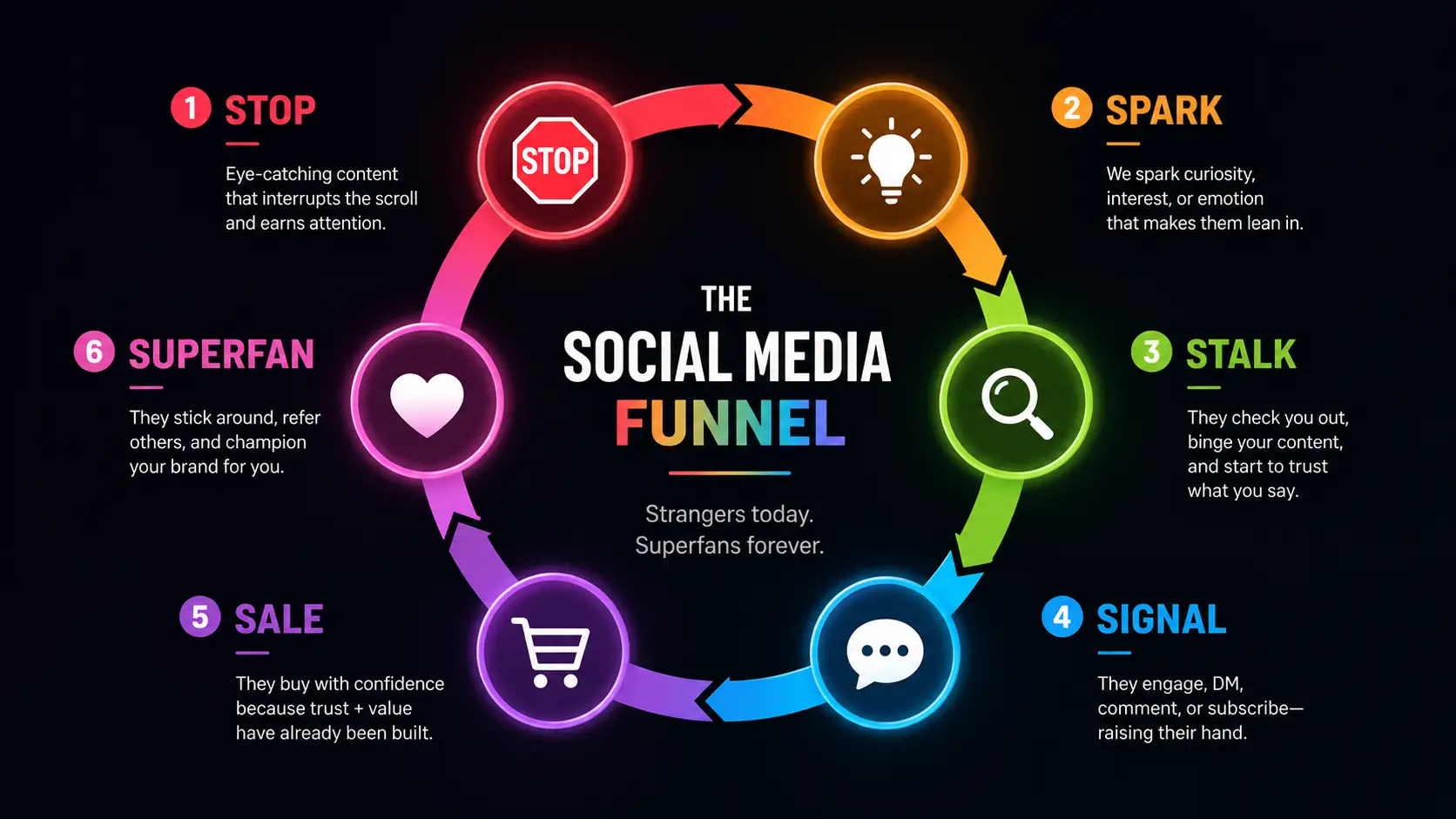
Here’s the thing about the modern social funnel, it’s not linear. It doesn’t go awareness → consideration → purchase in a neat little arrow. It loops, backtracks, and sometimes jumps straight from a Reel to a checkout page. So let’s map it out properly, stage by stage, and talk about what actually works at each one.
In this article
→ Stage 1: The Stop (Awareness)
→ Stage 2: The Spark (Interest)
→ Stage 3: The Stalk (Consideration)
→ Stage 4: The Signal (Intent)
→ Stage 5: The Sale (Conversion)
→ Stage 6: The Superfan (Loyalty)
Stage 1: The Stop (Awareness)
Goal: Interrupt the scroll. Just once.
You have about 1.3 seconds before someone’s thumb moves on. So awareness isn’t about reach, it’s about pattern interruption. The best-performing top-of-funnel content in 2026 leans into tension, contrast, or unexpectedness. A bold claim. A counterintuitive take. A visual that feels slightly off.
What works here?
Reels, TikToks, bold carousels, controversial takes, memes, and lo-fi UGC-style content. Algorithmic reach is still king at this stage, lean into it.
Stage 2: The Spark (Interest)
Goal: Make them curious enough to want more.
They stopped. Now what? The interest stage is where most brands drop the ball. They either go straight for the sell (too early) or post generic content that doesn’t deepen the relationship. What you want here is to establish a point of view. Share something useful, surprising, or relatable. Make them think “okay, this brand gets it.”
What works here?
Saveable carousels, educational content, hot takes, behind-the-scenes, founder stories, or real customer results. The save button is your best friend at this stage.
Stage 3: The Stalk (Consideration)
Goal: Survive the deep dive.
Here’s what nobody tells you: your best prospects are silently stalking your profile right now. They’re scrolling your grid, reading your bio, checking your highlights. This is the consideration stage and your profile is a landing page. Treat it like one. Consistency of voice, social proof in the feed, and a bio that answers “who is this for and why should I care?”
What works here?
Pinned posts, highlight reels, testimonial-heavy content, before/after posts, FAQ content, and consistent aesthetic. Think of your profile grid as a first impression — because it is.
Stage 4: The Signal (Intent)
Goal: Catch the warm signals before your competitor does.
Likes are passive. But when someone DMs you, clicks your link in bio, replies to your Story, or comments a question, that’s a buying signal. This is where the funnel gets personal. Your retargeting ads, DM flows, and Story CTAs should all be built to capture and respond to intent signals fast. Speed to respond here is directly correlated with conversion.
What works here?
Retargeting campaigns, Instagram DM automation, Story polls and quizzes, lead magnets, link-in-bio tools with tracking, and personalized outreach to engaged followers.
Stage 5: The Sale (Conversion)
Goal: Remove every possible reason to say “not today.”
The conversion stage isn’t where you sell harder, it’s where you reduce friction. Abandoned cart content, limited-time offers, objection-handling posts (“is it really worth it?”), and user-generated content from real customers all do the heavy lifting here. Social proof at this stage is everything. One authentic review will outperform ten polished ads.
What works here?
UGC testimonials, scarcity and urgency posts, comparison content, shoppable posts, paid retargeting with strong offers, and frictionless checkout via native social commerce.
Stage 6: The Superfan (Loyalty)
Goal: Turn buyers into your best marketers.
The funnel doesn’t end at the sale that’s where most brands stop, and it’s their biggest mistake. Post-purchase, your job is to create moments that make customers feel like insiders. Exclusive content, community access, repost opportunities, and loyalty shoutouts turn a one-time buyer into someone who sells on your behalf. Community-led growth is the most underrated strategy in 2026.
What works here?
Customer repost campaigns, branded hashtags, exclusive community groups, referral programs promoted on social, loyalty giveaways, and asking customers to share their experience publicly.
The one thing most marketers miss
Different content serves different funnel stages and mixing them up kills results. A conversion ad shown to a cold audience will flop. An awareness post shown to warm retargeting audiences wastes budget. Map your content to the stage, and the funnel starts working like it should.
The Bottom Line
The modern social media funnel isn’t about posting more. It’s about posting smarter.
Every post should have:
- A purpose
- A stage
- A next step
When you shift from random posting to strategic funnel thinking, everything changes.
Now go audit your last 10 posts and ask: what stage was that actually serving? You might be surprised by the answer.
1. What is a modern social media funnel?
A modern social media funnel is a non-linear customer journey that guides users from awareness to purchase and loyalty through strategic content stages.
2. Why is the social media funnel not linear anymore?
Because users interact with content in unpredictable ways they may jump stages, revisit content, or convert instantly.
3. Which platform works best for the awareness stage?
Platforms like Instagram Reels and TikTok perform best due to high algorithm-driven reach.
4. How do I know which stage my content belongs to?
Identify the goal of your post attention, engagement, trust or conversion and map it accordingly.
5. What is the most important stage in the funnel?
All stages are important, but intent and conversion stages directly impact revenue.
6. How can small businesses use this funnel effectively?
By focusing on consistent content, engaging storytelling, and quick responses to customer interactions.