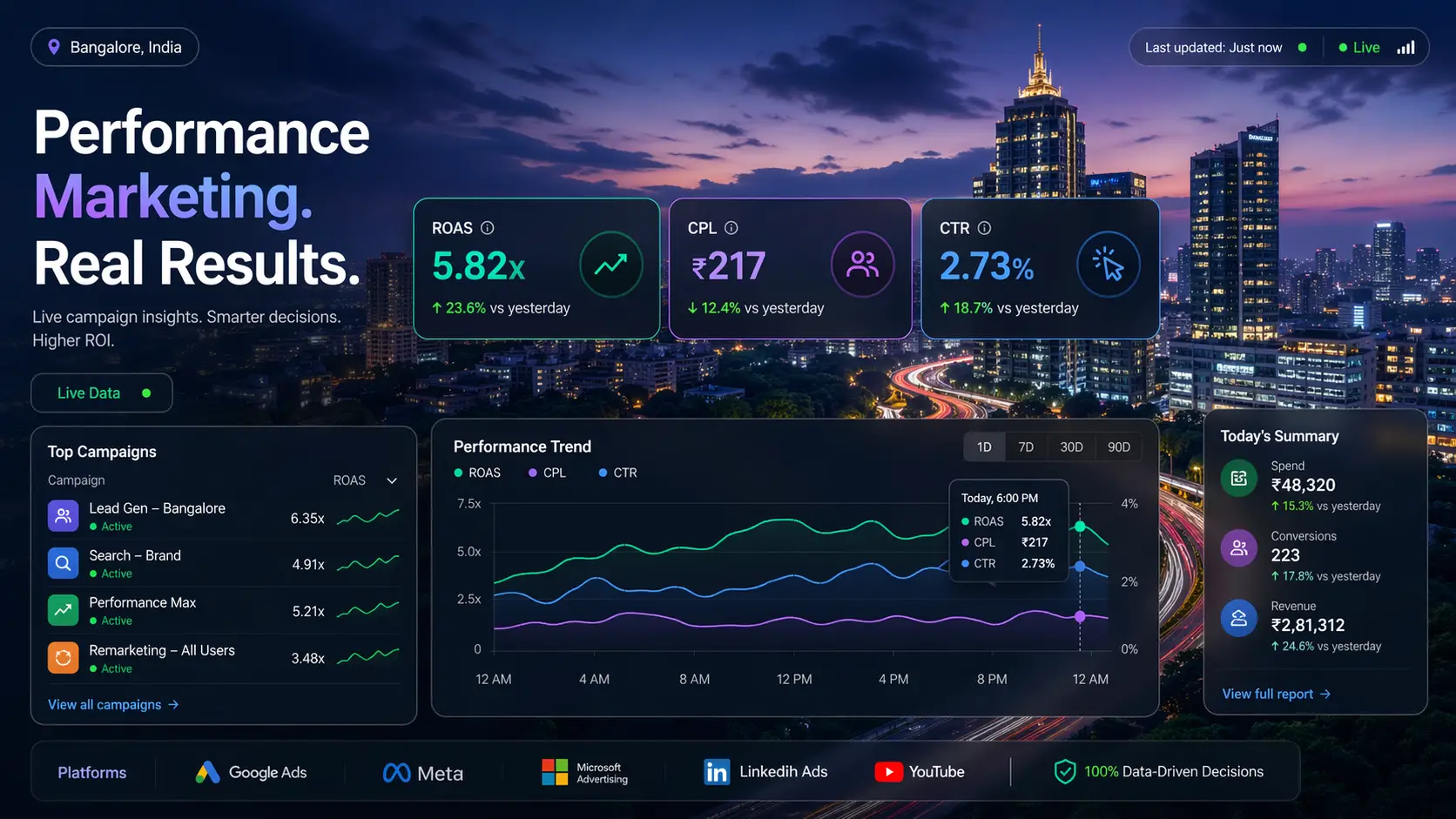
Imagine paying for a newspaper ad and having absolutely no idea how many people read it, called your business, or visited your website. That’s traditional marketing and for decades, it was the only option.
Now imagine running an ad campaign where every single rupee is tracked, every click is measured, and you only pay when someone takes a specific action a click, a lead, a sale. That’s performance marketing, and it’s changing the way Indian businesses grow.
Whether you’re a seasoned CMO at a large enterprise, a startup founder managing your first budget, or a fresher stepping into the world of digital marketing services, this guide is built for you.
At 3Percent.in, we’ve managed performance marketing campaigns across 50+ brands in India. This guide distills everything we’ve learned — with data, formulas, tables, and actionable frameworks to help you grow smarter, not just louder.
1. What Is Performance Marketing? (Definition)
Performance marketing is a results-driven digital advertising model where advertisers pay only when a specific, pre-defined action is completed such as a click, lead, app install, or sale. Unlike traditional advertising where you pay upfront for space or time, performance marketing ties every rupee of spend to a measurable outcome.
“Performance marketing is the only form of advertising where the business doesn’t pay for potential — it pays for proof.”
Core Principles of Performance Marketing
- Measurability: Every action is tracked through pixels, UTM parameters, and attribution tools.
- Accountability: Ad spend is directly tied to results — no results, no payment.
- Optimization: Campaigns are continuously refined using real-time data.
- Scalability: What works can be scaled instantly with more budget.
- Transparency: Advertisers see exactly where their money goes.
Performance Marketing vs. Traditional Marketing
Here’s a comprehensive comparison to help you understand the key difference:
| Parameter | Traditional Marketing | Performance Marketing |
| Payment Model | Upfront fixed costs | Pay only for results (CPC, CPL, CPA) |
| Measurability | Difficult to track | 100% trackable via pixels & analytics |
| Targeting | Broad audience | Hyper-targeted by demographics, intent |
| Budget Flexibility | Fixed, long-term | Flexible, real-time adjustable |
| Time to Results | Weeks to months | Days to weeks |
| Optimization | Post-campaign only | Continuous, real-time A/B testing |
| Risk Level | High (no guarantee) | Low (performance-linked spend) |
| Attribution | Near impossible | Multi-touch attribution models |
The verdict is clear: performance marketing gives Indian businesses — from Bangalore startups to Mumbai enterprises — the ability to spend smarter and scale faster.
2. How Performance Marketing Works: The Ecosystem
Performance marketing involves multiple stakeholders working together in a data-driven ecosystem:
Key Players in the Performance Marketing Ecosystem
- Advertisers (Brands): Companies like yours that want leads, sales, or installs.
- Publishers (Platforms): Google, Meta, LinkedIn, YouTube — where ads are shown.
- Affiliate Networks: Platforms like VCommission, Admitad India that connect brands with affiliates.
- Ad Networks / DSPs: Programmatic platforms that serve display ads at scale.
- Performance Agencies: Specialists like 3Percent.in that manage strategy, execution, and optimisation.
- Tracking & Analytics: Tools like Google Analytics 4, AppsFlyer, Adjust, and Meta Pixel.
The Performance Marketing Funnel
Understanding the marketing funnel is essential. Performance marketing works across all funnel stages, but the metrics and channels differ:
| Funnel Stage | Goal | Best Channel | Key Metric |
| TOFU – Awareness | Reach new audiences | YouTube, Meta, Programmatic | CPM, Reach, VTR |
| MOFU – Consideration | Nurture & educate | Google Display, LinkedIn | CTR, Engagement, Time-on-Site |
| BOFU – Conversion | Drive action | Google Search, Retargeting | CVR, CPA, ROAS |
| Retention | Repeat purchases | Email, Push, WhatsApp | CLV, Churn Rate, NPS |
3. Types of Performance Marketing Channels
India’s digital advertising market is projected to reach ₹57,000 crore by 2026 (IAMAI). Here are the most powerful performance marketing channels available today:
3.1 Search Engine Marketing (SEM / PPC)
Google Search Ads remain the most powerful performance channel for capturing high-intent buyers. When someone searches ‘best CRM software India’ or ‘performance marketing agency in Bangalore,’ your ad appears at the top. You pay only when they click.
- Best for: B2B, e-commerce, services, local businesses
- Pricing Model: Cost Per Click (CPC)
- Strengths: Highest purchase intent, immediate results, measurable ROI

3.2 Social Media Advertising (Meta, LinkedIn, Twitter)
Meta Ads (Facebook & Instagram) offer unmatched audience targeting by age, interest, location, behaviour, and even life events. LinkedIn Ads are the go-to for B2B marketers targeting decision-makers.
- Best for: D2C brands, B2C, B2B lead generation, app installs
- Pricing Model: CPM, CPC, CPL, CPA
- India Advantage: India has 500M+ active social media users, massive addressable audience
3.3 Programmatic Advertising
Programmatic uses AI and real-time bidding (RTB) to automatically buy ad inventory across thousands of websites, apps, and platforms. It’s ideal for retargeting reaching users who visited your website but didn’t convert.
3.4 Affiliate Marketing
In affiliate marketing, you partner with publishers, bloggers, and influencers who promote your product. They earn a commission only when they drive a sale or lead. Zero risk, you pay only for results.
•Popular in India: E-commerce (Flipkart, Amazon affiliates), fintech, EdTech
3.5 Influencer Performance Marketing
Unlike traditional influencer marketing (pay-per-post), performance-based influencer marketing ties compensation to actual outcomes — tracked via unique promo codes, affiliate links, or UTM parameters.
3.6 Email & WhatsApp Marketing
With India having 500M+ WhatsApp users, performance-based messaging campaigns deliver exceptional ROI — especially for retention, upsell, and re-engagement.
Channel Comparison: Where Should You Invest?
| Channel | Best For | Avg. CPC (India) | Targeting Strength | ROI Potential |
| Google Search Ads | High-intent buyers | ₹10–₹60 | ★★★★★ | ★★★★★ |
| Meta (FB/IG) Ads | B2C, D2C brands | ₹3–₹25 | ★★★★★ | ★★★★☆ |
| YouTube Ads | Brand storytelling | ₹0.25–₹2/view | ★★★★☆ | ★★★★☆ |
| LinkedIn Ads | B2B, SaaS, Hiring | ₹80–₹300 | ★★★★★ | ★★★★☆ |
| Affiliate Marketing | E-commerce, D2C | Revenue share | ★★★☆☆ | ★★★★★ |
| Programmatic Display | Retargeting, scale | ₹2–₹15 | ★★★★☆ | ★★★☆☆ |
4. Top Metrics in Performance Marketing (By Objective)
This is the most technically important section of this guide. Choosing the wrong metric for your objective is one of the most common and costly mistakes marketers make. Here’s a complete framework:
| Objective | Primary Metric | Formula | Benchmark (India) |
| Lead Generation | CPL (Cost Per Lead) | Total Spend ÷ No. of Leads | ₹150–₹800 |
| E-commerce Sales | ROAS (Return on Ad Spend) | Revenue ÷ Ad Spend | 3x–6x |
| Brand Awareness | CPM (Cost Per 1000 Impressions) | Spend ÷ Impressions × 1000 | ₹30–₹150 |
| App Downloads | CPI (Cost Per Install) | Total Spend ÷ Installs | ₹20–₹80 |
| Website Traffic | CPC (Cost Per Click) | Total Spend ÷ Clicks | ₹5–₹50 |
| Customer Retention | CLV (Customer Lifetime Value) | Avg. Order Value × Purchase Freq × Lifespan | Industry-specific |
| Conversions | CVR (Conversion Rate) | Conversions ÷ Total Visitors × 100 | 2%–5% |
| Revenue Growth | ROI (Return on Investment) | (Revenue − Cost) ÷ Cost × 100 | >150% |
Essential Performance Marketing Formulas
Every marketer — from a fresher to a CMO — must know these formulas cold:
|
|
|
|
|
|
|
⚡ Pro Tip from 3%: The ‘North Star’ Metric Framework:
- For Lead Generation campaigns → Optimise for CPL first, then quality of leads
- For E-commerce campaigns → Optimise for ROAS, targeting 4x minimum
- For App campaigns → Start with CPI, then shift to in-app event optimisation
- For Brand campaigns → Use CPM + Brand Lift Studies to measure recall
5. Building a Performance Marketing Strategy from Scratch
Whether you’re a CMO setting quarterly targets or a new marketer launching your first campaign, follow this proven 7-step framework:
Step 1: Define Clear Business Objectives (SMART Goals)
Never start a campaign without crystal-clear goals. Vague goals like ‘get more leads’ will get you nowhere. Use the SMART framework:
- Specific: ‘Generate 500 qualified leads for our B2B SaaS product’
- Measurable: ‘CPL should not exceed ₹400’
- Achievable: Based on industry benchmarks
- Relevant: Tied to business revenue targets
- Time-bound: ‘Within Q3 FY2025-26’
Step 2: Know Your Audience Deeply
- Build detailed buyer personas (demographics, psychographics, pain points, intent signals)
- Use tools: Google Analytics 4, Meta Audience Insights, SEMrush, SpyFu
- For B2B in India: LinkedIn Audience Insights is invaluable
- Understand the Indian consumer journey — often starts on mobile, influenced by regional content
Step 3: Set Your Budget and Bidding Strategy
Budget allocation should follow your funnel structure. A typical performance budget split for Indian brands:
- 40% to Acquisition: Google Search + Meta Lead Gen Ads
- 30% to Retargeting: Programmatic + Google Display + Meta Retargeting
- 20% to Retention: Email, WhatsApp, Push Notifications
- 10% to Experimentation: New channels, new creatives, A/B tests
Step 4: Choose the Right Channels
Based on your objective, audience, and budget, select 2–3 primary channels. Don’t spread too thin. Focus, test, then scale what works.
Step 5: Create High-Converting Ad Creatives
In India, creative quality directly determines campaign success. Key principles:
- Use regional languages for Tier 2 & Tier 3 cities (Hindi, Kannada, Tamil, Telugu)
- Mobile-first creatives — 80%+ of Indian internet users are mobile-first
- Video content outperforms static by 3x on Meta and YouTube
- Use social proof — testimonials, case studies, and review-based creatives work exceptionally well
Step 6: Set Up Tracking & Attribution
This is non-negotiable. Without proper tracking, you’re flying blind.
- Install: Meta Pixel, Google Tag Manager, GA4, LinkedIn Insight Tag
- Use UTM Parameters: Tag every URL to track source, medium, campaign, content
- Attribution Model: Use Data-Driven Attribution in GA4 for accurate credit allocation
- App campaigns: Use AppsFlyer or Adjust for mobile attribution
Step 7: Optimise, Test & Scale
- Run weekly performance audits (CPL, ROAS, CTR, CVR)
- A/B test one variable at a time — headline, image, CTA, audience
- Kill underperforming ad sets quickly — don’t let them drain budget
- Scale winners gradually (increase budget by 20–30% every 3–5 days to avoid algorithm disruption)
- Review monthly with CMO-level dashboards: spend, revenue, ROAS, CLV, CAC

6. Performance Marketing in India: The Unique Landscape
India’s digital ecosystem has unique characteristics that performance marketers must understand:
The Indian Digital Consumer
- 2 billion mobile connections: Mobile-first campaigns are non-negotiable
- Price sensitivity: Indian consumers respond strongly to discounts, EMI options, and social proof
- Regional diversity: A pan-India campaign needs regional creative variants
- Festive marketing: Diwali, Dussehra, New Year, IPL — seasonal spikes offer massive performance opportunities
- Rising Tier 2/3 cities: Jaipur, Lucknow, Coimbatore are emerging performance marketing goldmines
Why Bangalore is India’s Performance Marketing Hub
As a leading performance marketing agency in Bangalore, 3Percent.in operates at the heart of India’s tech and startup ecosystem. Bangalore brands — from Series A startups to global MNCs — demand performance-first marketing because:
- High density of tech-savvy, high-income consumers
- Fastest-growing D2C and SaaS market in India
- Investor pressure for CAC efficiency and ROAS accountability
- Access to India’s best performance marketing talent
Compliance & Privacy in Indian Performance Marketing
- DPDP Act (Digital Personal Data Protection Act, 2023) — compliance is mandatory for data collection
- Cookie deprecation: Shift to first-party data strategies now
- Google’s Enhanced Conversions and Meta’s Conversions API are the future of tracking
7. Tools Every Performance Marketer Needs in 2026
Analytics & Tracking
- Google Analytics 4 (GA4): The gold standard for web analytics and conversion tracking
- Google Tag Manager: Manage all tracking tags without developer dependency
- AppsFlyer / Adjust: Mobile app attribution and analytics
Advertising Platforms
- Google Ads: Search, Display, YouTube, Shopping — the backbone of performance marketing
- Meta Ads Manager: Facebook & Instagram — unmatched B2C targeting
- LinkedIn Campaign Manager: Best for B2B lead generation in India
Optimisation & Intelligence
- SEMrush / Ahrefs: Competitor research, keyword analysis
- Hotjar / Microsoft Clarity: Heatmaps to improve landing page CVR
- Canva / Adobe Express: Rapid creative production for ad variants
8. Common Performance Marketing Mistakes (And How to Avoid Them)
⚡ Critical Mistakes That Kill Performance Marketing ROI:
- Setting vague goals (‘more traffic’) instead of specific KPIs
- Not installing tracking before launching campaigns
- Running ads to a poorly designed landing page (CVR killer)
- Ignoring mobile optimisation, 80%+ of Indian traffic is mobile
- Scaling budget too fast before validating creative and audience
- Focusing only on CTR and ignoring conversion quality
- Not running retargeting campaigns (you’re leaving 70% revenue on the table)
- Copying competitor ads without understanding your unique value proposition
9. How to Choose the Right Performance Marketing Agency in India
Choosing a performance marketing agency in Bangalore or any other city is a critical business decision. Here’s what to look for:
Green Flags: What a Great Agency Looks Like
- Shares case studies with actual numbers (ROAS, CPL, revenue impact)
- Proposes a custom strategy, not a templated package
- Sets up comprehensive tracking and reporting from day one
- Communicates proactively with weekly/bi-weekly performance reviews
- Has deep platform certifications: Google Partner, Meta Business Partner
- Understands your industry, customer journey, and competitive landscape
Red Flags: Walk Away If You See These
- Guarantees specific results without understanding your business
- Can’t explain their attribution model clearly
- Provides vanity metrics (impressions, reach) instead of revenue metrics
- Locks you into long-term contracts before proving performance
- No dedicated account manager or transparent reporting dashboard
At 3Percent.in, we operate as a true growth partner — aligned to your revenue targets, not just your ad spend. Our expertise as a google advertising company spans across Search, YouTube, Meta, Programmatic, and full-funnel attribution — making us one of the most trusted performance-first agencies in India.
10. The Future of Performance Marketing in India (2025–2027)
AI-Powered Campaigns
Google’s Performance Max, Meta’s Advantage+ Shopping, and AI-generated creatives are fundamentally changing how campaigns are optimised. Marketers who master AI tools will have a massive edge.
First-Party Data Will Be King
With cookie deprecation and the DPDP Act, brands that build strong first-party data assets — CRM databases, email lists, WhatsApp opt-ins — will outperform competitors still relying on third-party data.
Video Performance Marketing
YouTube Shorts, Instagram Reels, and Connected TV (CTV) ads are emerging as high-performing channels. Short-form video with direct-response CTAs is the next big frontier for Indian performance marketers.
Omnichannel Attribution
The future belongs to brands that can accurately attribute revenue across online and offline touchpoints — from Google Search to a sales call to an in-store visit. Invest in robust attribution infrastructure now.
Frequently Asked Questions (FAQs): Performance Marketing
Q1. What is the difference between performance marketing and digital marketing?
Digital marketing is an umbrella term covering all online marketing activities — SEO, social media, content, email, and paid ads. Performance marketing is a specific subset of digital marketing where advertisers pay only for measurable results like clicks, leads, or sales. All performance marketing is digital marketing, but not all digital marketing is performance marketing.
Q2. How much should I budget for performance marketing in India?
There’s no one-size-fits-all answer. For startups in Bangalore and other metros, a starting budget of ₹50,000–₹1,50,000 per month is realistic for testing and early traction. Mid-market companies should allocate ₹3–10 lakhs per month for meaningful scale. Enterprise brands invest ₹25 lakhs and above monthly. The key is to start with a focused budget on 1–2 channels, validate your CPL or ROAS, and then scale what works and forecast using tools like the Free Google Ads Calculator for Benchmark.
Q3. What is a good ROAS for e-commerce in India?
A ROAS of 3x (₹3 revenue for every ₹1 spent) is generally the break-even point for most e-commerce businesses in India, accounting for product cost, shipping, and operational expenses. A healthy ROAS target is 4x–6x. High-margin D2C brands (beauty, supplements, fashion) often achieve 6x–10x ROAS on optimised campaigns. Always calculate your break-even ROAS first — it depends on your gross margins.
Q4. Is performance marketing suitable for B2B companies in India?
Absolutely. B2B performance marketing in India is booming, particularly on LinkedIn Ads (for CXO and decision-maker targeting), Google Search (for intent-based discovery), and email marketing automation. The key difference is that B2B cycles are longer, so optimise for Marketing Qualified Leads (MQLs) and Sales Qualified Leads (SQLs) rather than pure lead volume. Expected CPL for B2B SaaS in India ranges from ₹500–₹3,000 depending on deal size.
Q5. How long does it take to see results from performance marketing?
For paid search and social campaigns, you can typically see early data (impressions, clicks, first leads) within 24–72 hours of launch. However, meaningful optimisation and stable performance usually requires 4–8 weeks of data collection and testing. Budget for at least 3 months to properly evaluate a performance marketing strategy. Channels like SEO take 6–12 months but compound significantly over time.
Q6. What is the role of landing pages in performance marketing?
Landing pages are arguably the most critical element of any performance marketing campaign. You can have perfect targeting and a great ad, but if the landing page is slow, unclear, or untrusted, your conversion rate will tank. Key principles: single, clear CTA; social proof (reviews, logos, case studies); fast load time (under 3 seconds on mobile); form with minimal fields; and consistent messaging from ad to landing page. A well-optimised landing page can double your conversion rate — effectively halving your CPL.
Q7. What is multi-touch attribution and why does it matter?
Multi-touch attribution is the process of assigning credit for a conversion to multiple touchpoints in the customer journey — not just the last click. For example, a customer might discover your brand through a YouTube ad, then search on Google, then see a retargeting ad on Instagram before converting. Last-click attribution gives 100% credit to Google Search, missing the role of YouTube and Instagram. Multi-touch models (Linear, Time-Decay, Data-Driven) give a more accurate picture of what’s driving revenue, helping you invest budget more effectively. Google Analytics 4’s Data-Driven Attribution is the recommended model for most Indian businesses.
Q8. How do I measure performance marketing success as a CMO?
As a CMO, focus on these board-level metrics: Customer Acquisition Cost (CAC) vs. Customer Lifetime Value (CLV) — you want CLV to be at least 3x CAC. Overall Return on Marketing Investment (ROMI). Revenue attribution by channel. Month-over-month lead/sale growth. Market share metrics. Below these, your performance marketing team should be optimising CPL, ROAS, CVR, and CPC at the campaign level. Build a single-source-of-truth dashboard (using tools like Looker Studio) that connects ad platform data to CRM data to actual revenue.
Q9. What is the difference between CPA and CPL?
CPL (Cost Per Lead) measures how much you spend to generate one lead, typically a form fill, sign-up, or inquiry. CPA (Cost Per Acquisition) is broader and measures the cost of any desired action, which could be a sale, a sign-up, an app install, or a trial activation. In e-commerce, CPA typically refers to the cost of a purchase. In lead gen, CPA and CPL are often used interchangeably. The key is to define what ‘acquisition’ means for your business before setting targets.
Q10. Why should I work with a performance marketing agency instead of doing it in-house?
Both approaches have merit, and the right choice depends on your scale and internal capabilities. Agencies bring immediate expertise, platform partnerships (Google, Meta preferred partnerships), access to industry benchmarks, and full-team bandwidth (media buyer, creative strategist, analytics expert) at a fraction of the cost of hiring all three in-house. In-house teams excel at deep brand knowledge and long-term institutional learning. Many mature organisations use a hybrid model, an internal performance lead who manages an external agency for execution and media buying. As a performance marketing agency in Bangalore, 3Percent.in works with companies at every stage of this journey.
Conclusion: Performance Marketing Is Not Optional in 2026
The Indian digital economy is growing at an unprecedented pace and with it, the competition for consumer attention and wallet share. Performance marketing is no longer a ‘nice to have.’ It is the foundation of sustainable, scalable business growth.
Whether you’re optimising an existing funnel or building your performance marketing engine from scratch, the principles are the same: set clear goals, measure everything, test relentlessly, and invest in what works.
At 3Percent.in, we partner with ambitious brands to build performance marketing systems that deliver real, measurable business impact, not just vanity metrics. If you’re ready to make every rupee of your marketing budget accountable, our team of performance experts is here to help. From digital marketing services to full-funnel performance strategy, we’ve got you covered.
| Ready to scale your performance marketing in India? Talk to our experts at 3Percent.in — Performance Marketing Agency in Bangalore that delivers results, not just reports. |
About 3Percent.in
3% Collective is performance marketing agency in MG Road, Bangalore specializing in paid search, social media advertising, programmatic, and full-funnel digital growth strategies. We serve startups, D2C brands, and enterprise clients across India with data-first, ROI-obsessed marketing solutions.