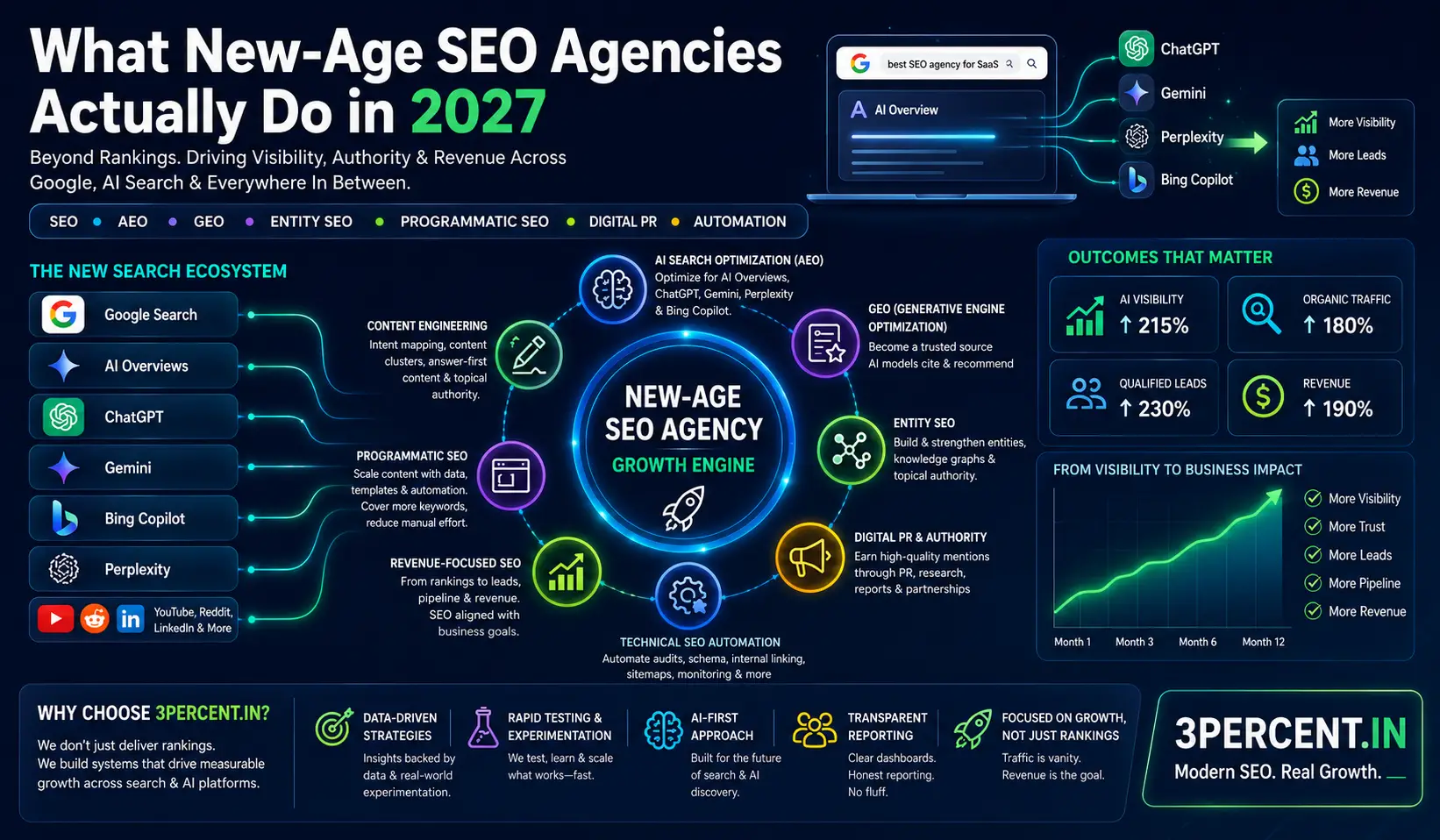
What New-Age SEO Agencies Actually Do in 2026-2027
For years, businesses evaluated SEO agencies using a simple checklist:
- How many keywords are ranking?
- How many backlinks did they build?
- How many blogs did they publish?
In 2026, those questions still matter, but they are no longer enough.
Today, users discover brands through Google AI Overviews, ChatGPT, Gemini, Bing Copilot, Perplexity, YouTube, Reddit, LinkedIn, and industry-specific platforms. As a result, modern SEO agencies are evolving beyond traditional ranking tactics and becoming growth partners focused on visibility, authority, leads, and revenue.
If you’re a founder, marketing leader, startup owner, D2C brand, B2B company, or enterprise evaluating SEO partners, understanding what a modern agency does differently can save you months of wasted budget and missed opportunities.
Quick Answer
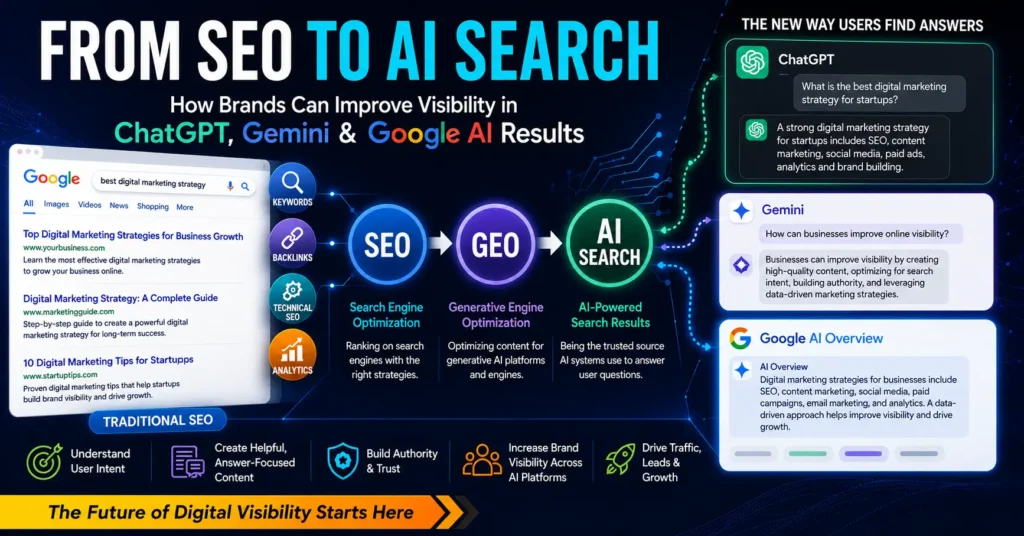
A new-age SEO agency focuses on AI Search Optimization (AEO), Generative Engine Optimization (GEO), entity building, programmatic SEO, digital PR, technical automation, and revenue-driven growth strategies. Instead of only improving rankings, they help brands become visible across Google AI Overviews, ChatGPT, Gemini, Bing, and other AI-powered search experiences.
Why Traditional SEO Alone Is No Longer Enough
Search behavior has changed dramatically.
A user searching for software recommendations may receive:
- A Google AI Overview
- A ChatGPT recommendation
- A Perplexity answer
- A Reddit discussion
- A YouTube review
without ever clicking ten blue links.
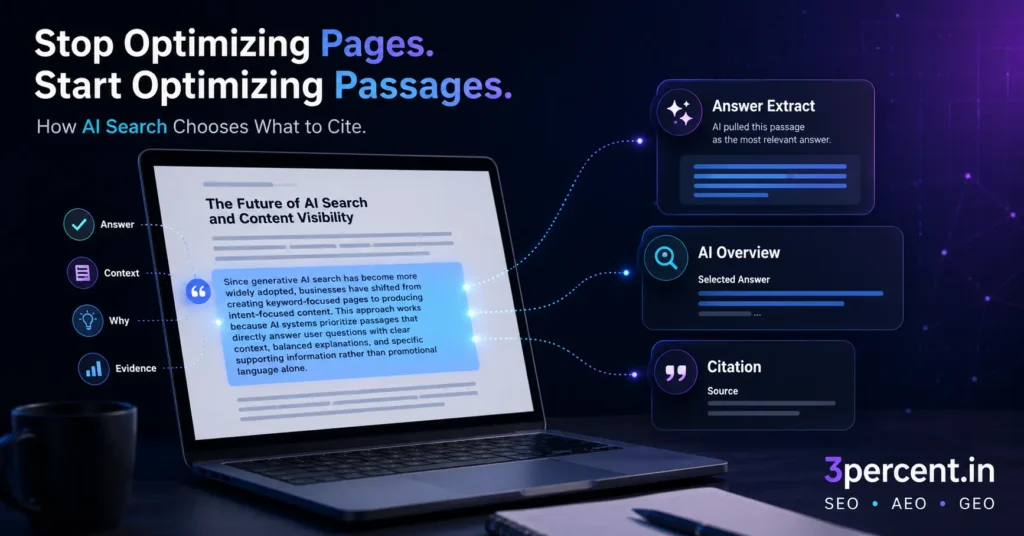
This shift means businesses must optimize not only for search engines but also for AI systems that summarize, recommend, and cite information.
According to Google’s guidance on AI-powered search experiences, high-quality, original, people-first content remains a critical factor in visibility across modern search ecosystems.
Why Search Engines Are Prioritizing Helpful Content
Google has consistently emphasized that websites should create helpful, people-first content designed to serve users rather than search engines. As AI-powered search experiences continue to evolve, businesses that publish original insights, expert opinions, case studies, and real-world experience are more likely to earn visibility across both traditional search results and AI-generated answers.
Reference:
Google Search Central – Creating Helpful Content
Traditional SEO vs Modern SEO Agency
| Traditional SEO Agency | Modern SEO Agency |
|---|---|
| Keyword rankings | Business outcomes |
| Monthly blog quotas | Content systems |
| Backlink counts | Authority building |
| Traffic reporting | Revenue reporting |
| Google-only focus | Multi-platform visibility |
| Manual processes | Automated workflows |
| SEO reporting | Growth experimentation |
1. AI Search Optimization (AEO)
One of the biggest changes in SEO is Answer Engine Optimization (AEO).
Modern agencies optimize content to appear in:
- Google AI Overviews
- ChatGPT responses
- Gemini answers
- Bing Copilot
- Perplexity
This requires:
Structured Answers
Content must directly answer questions.
Entity Clarity
AI systems need clear understanding of:
- Brand
- Product
- Service
- Founder
- Industry
Topical Authority
Brands must demonstrate expertise across an entire subject area rather than isolated keywords.
How AI Search Engines Evaluate Content
While every AI platform uses different systems, most rely on similar signals:
- Content quality
- Topic expertise
- Brand authority
- Structured data
- Original research
- User trust signals
Google, Microsoft Bing, and other search providers continue to recommend creating useful content that demonstrates expertise and answers user questions clearly.
References:
2. Generative Engine Optimization (GEO)
Generative Engine Optimization focuses on becoming a trusted source cited by AI systems.
Key GEO activities include:
Original Research
Publishing unique industry insights.
First-Hand Experience
Sharing actual client experiences and case studies.
Expert Commentary
Providing opinions backed by real-world expertise.
Data-Driven Content
Creating content AI systems can confidently reference.
This aligns closely with Google’s emphasis on Experience, Expertise, Authoritativeness, and Trustworthiness (E-E-A-T).
3. Programmatic SEO
Rather than manually creating hundreds of pages, modern agencies use structured data and automation to scale content production.
Examples include:
- Location pages
- Product comparison pages
- Industry solution pages
- Service variations
- Resource hubs
Example
Instead of creating 500 individual pages manually, a scalable content system generates and maintains them efficiently.
This allows businesses to dominate large keyword categories without scaling content teams proportionally.
4. Entity SEO and Knowledge Graph Optimization
Search engines increasingly evaluate entities rather than keywords.
An entity may include:
- A company
- A founder
- A product
- A service
- A location
Modern SEO agencies build entity relationships using:
- Schema markup
- Author profiles
- Organization profiles
- Structured citations
- Digital PR mentions
The goal is to strengthen how search engines and AI systems understand your brand.
5. Digital PR Instead of Link Building
Traditional SEO often focused on acquiring backlinks.
Modern agencies prioritize:
- Industry mentions
- Media coverage
- Research reports
- Expert commentary
- Thought leadership
The outcome is stronger brand authority and better visibility in both search engines and AI-generated answers.
6. Technical SEO Automation
Many SEO tasks can now be automated.
Examples include:
Internal Linking
Automated recommendations and implementation.
Schema Deployment
Scalable structured data generation.
Content Auditing
Monitoring outdated content and opportunities.
Site Health Monitoring
Detecting issues before they affect visibility.
This enables agencies to spend less time on repetitive tasks and more time on strategic growth initiatives.
7. Revenue-Focused SEO
The best agencies no longer celebrate rankings alone.
Instead, they ask:
- Which pages generate leads?
- Which content influences revenue?
- Which channels reduce customer acquisition costs?
- Which topics create qualified pipeline opportunities?
This approach aligns SEO with business growth rather than vanity metrics.
What We See at 3Percent.in
At Three Percent Collective, we have observed a growing shift among startups, D2C brands, SaaS companies, educational institutions, publishers, and enterprise organizations.
The businesses seeing the strongest growth are combining:
- SEO
- AEO
- GEO
- Content engineering
- Entity optimization
- Technical automation
Rather than treating SEO as a content production exercise, they view search visibility as a business growth system.
This approach creates stronger long-term results while improving visibility across both traditional search engines and AI-powered discovery platforms.
The Future of SEO Is Multi-Platform Visibility
Businesses should no longer ask:
“How do I rank #1?”
Instead ask:
“How do I become the most trusted answer?”
That means being visible across:
- Google Search
- Google AI Overviews
- ChatGPT
- Gemini
- Bing Copilot
- Perplexity
- YouTube
The brands that build authority across these ecosystems will have a significant competitive advantage over the next decade.
Sourc
Final Thoughts
The best SEO agencies in 2026 do far more than publish blogs and build backlinks.
They combine AI Search Optimization, GEO, Entity SEO, Programmatic SEO, Technical Automation, Digital PR, and Revenue Analytics to help businesses grow.
If you’re evaluating an SEO partner, look beyond rankings and ask whether they understand how modern search works.
Because the future of SEO isn’t simply ranking higher.
It’s becoming the answer.
Frequently Asked Questions
1. What is a new-age SEO agency?
A new-age SEO agency focuses on AI search visibility, AEO, GEO, entity SEO, technical automation, digital PR, and revenue growth rather than just keyword rankings.
2. What is the difference between SEO and AEO?
SEO focuses on ranking in search engines, while AEO focuses on becoming the answer shown in AI-powered search experiences such as Google AI Overviews, ChatGPT, and Gemini.
3. Is link building still important in 2026?
Yes, but quality matters more than quantity. Digital PR, brand mentions, and authority signals are increasingly important.
4. What is GEO in SEO?
Generative Engine Optimization (GEO) helps brands become trusted sources cited by AI systems and answer engines.
5. What industries benefit most from AEO?
SaaS, D2C, B2B services, healthcare, education, publishing, finance, eCommerce, and enterprise businesses.
6. What is Entity SEO?
Entity SEO helps search engines understand relationships between your brand, products, services, founders, and expertise.
7. Does Google support AI-optimized content?
Google supports people-first, helpful, experience-driven content that provides unique value and expertise.
8. Can startups compete with large brands using AEO?
Yes. AI search often rewards expertise, authority, and helpful content over brand size alone.
9. How long does modern SEO take?
Most businesses see meaningful improvements within 3–6 months, with stronger authority gains over 6–12 months.
10. How do I choose the right SEO agency?
Look for expertise in AEO, GEO, technical SEO, entity optimization, digital PR, analytics, and business-focused reporting rather than keyword rankings alone.