
Why AI Search Rewards Individual Paragraphs More Than Entire Articles
Traditional SEO taught us to optimize pages.
Generative AI is teaching us to optimize passages.
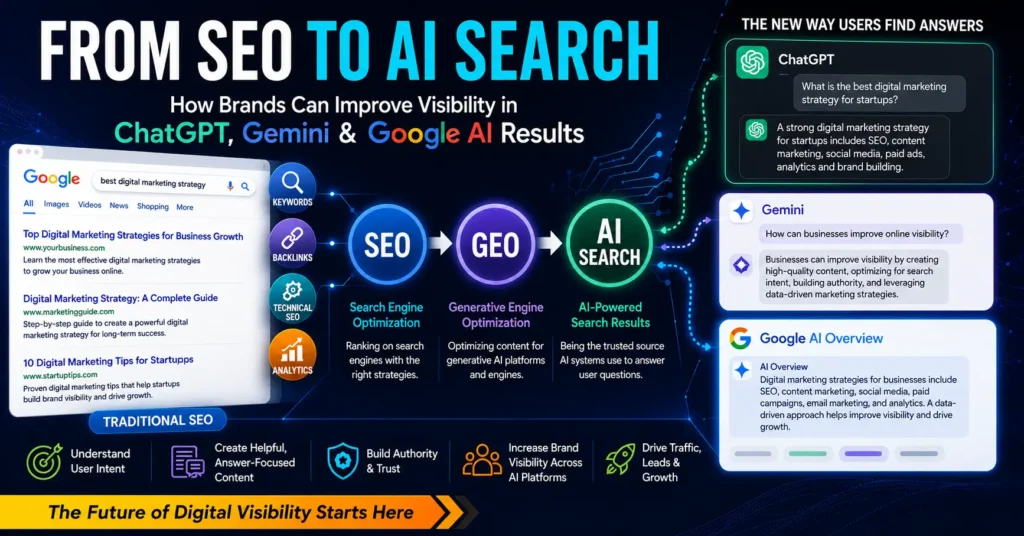
Whether someone uses ChatGPT, Google AI Overviews, Gemini, Claude, or Perplexity, the response rarely includes an entire article. Instead, these systems extract one or two highly relevant paragraphs that best answer the user’s question.
This changes how content should be written.
Ranking on Google is still important, but becoming AI-citable requires another layer of optimization. Instead of asking, “Is this page optimized?”, content teams should ask:
“If an AI model needed a 100-word answer from this article, which paragraph would it choose?”
If you don’t know the answer, your content probably isn’t optimized for modern search.
AI Doesn’t Read Like Humans
Humans usually scan headings, images, examples, and stories before reaching a conclusion.
AI models work differently.
They search for passages that are:
- self-contained
- factually clear
- easy to understand
- context-rich
- directly answer a question
A beautifully written introduction may never appear in an AI response if it doesn’t provide an immediate answer.
This is why content should be written in extractable blocks, not just long flowing narratives.
Four Writing Patterns That Increase AI Extractability
1. Make Every Important Claim Specific
Generic statements are difficult to reuse.
Instead of saying:
Good SEO improves rankings.
Write:
Websites that consistently publish topic-focused content, strengthen internal linking, and maintain technical SEO typically improve topical authority over time, making it easier for search engines to understand subject expertise.
The more precise your explanation is, the more confidence an AI model has when selecting it as an answer.
Specificity doesn’t always require statistics.
It can include:
- measurable outcomes
- timelines
- quantities
- comparisons
- defined scenarios
The goal is to remove ambiguity.
2. Always Explain Why Something Works
Many articles stop after making a conclusion.
AI systems prefer complete explanations.
Instead of writing:
Internal linking improves SEO.
Write:
Internal linking improves SEO because it helps search engines understand relationships between related topics while distributing authority across important pages. It also makes it easier for users to discover relevant content without returning to search results.
Notice the difference.
The second version answers both:
- What happens?
- Why does it happen?
Whenever possible, structure important paragraphs like this:
Answer → Reason → Outcome
This creates passages that can stand alone without requiring additional context.
3. Add Context, Conditions, and Exceptions
Real expertise rarely speaks in absolutes.
Instead of writing:
Long-form content performs better.
Write:
Long-form content generally performs better for informational searches where users expect detailed answers. However, shorter content may outperform comprehensive guides for simple transactional or navigational queries.
Adding qualifiers builds credibility.
Useful phrases include:
- in most industries
- depending on search intent
- unless
- except when
- for enterprise websites
- for local businesses
- during seasonal demand
Balanced content appears more trustworthy than overly confident statements.
4. Include Time-Based Context
Search evolves constantly.
Content without a time reference often feels generic.
Instead of writing:
AI search is changing SEO.
Write:
Since generative AI became a major part of search experiences, businesses have expanded their optimization strategies beyond traditional rankings to include AI visibility, answer engines, and conversational search.
Time anchors help readers and AI systems — understand whether information reflects the current landscape.
Examples include:
- over the past year
- since Google’s latest updates
- in recent months
- as AI adoption continues to grow
This small change makes content more relevant.
Think Like an AI Extractor
Every H2 section in your article should answer one question completely.
A strong AI-friendly passage usually contains:
- A direct answer
- Supporting explanation
- Relevant context
- Practical implication
- Any important limitation
If someone copied only those five sentences into a chatbot response, they should still make complete sense.
That’s the standard every important paragraph should meet.
Audit Existing Content Before Publishing
Before hitting Publish, review your article passage by passage, not page by page.
Ask yourself:
- Does this paragraph answer a specific question?
- Is the claim supported with meaningful context?
- Have I explained why this is true?
- Are there any conditions or limitations?
- Does it reflect today’s search landscape?
- Could this paragraph stand alone if quoted elsewhere?
If most answers are “No,” rewrite the passage.
Small improvements across a few important sections often have a greater impact than adding another thousand words.
The Future of SEO Is Passage Optimization
For years, SEO has focused on optimizing URLs.
AI search is shifting the focus toward optimizing answers.
The brands that earn visibility won’t necessarily publish the longest articles. They’ll publish the clearest, most reusable explanations.
That means writing paragraphs that are complete, factual, easy to extract, and useful without requiring additional context.
As AI-powered search continues to evolve, success will depend less on how many words you publish and more on how many of those words deserve to be quoted.
Frequently Asked Questions
1. What is passage optimization in SEO?
Passage optimization is the process of writing individual paragraphs that fully answer a user’s question. Instead of optimizing only an entire page, marketers optimize specific sections so search engines and AI models can extract them as standalone answers.
2. Why are AI search engines focused on passages instead of full articles?
Large language models retrieve and summarize the most relevant sections of a page rather than presenting the entire article. Clear, context-rich passages are easier for AI systems to understand and reuse in responses.
3. How can I make my content more AI-citable?
Focus on writing direct answers, explaining why something works, using specific examples, adding relevant context, acknowledging limitations, and keeping each important paragraph self-contained.
4. Does passage optimization replace traditional SEO?
No. Passage optimization complements traditional SEO. Technical SEO, keyword research, internal linking, page experience, and backlinks remain essential, while passage optimization improves the likelihood of your content being referenced by AI-powered search experiences.
5. How should content teams audit articles for AI optimization?
Review each key paragraph independently. Ask whether it answers a question clearly, includes supporting context, explains the reasoning, provides practical value, and makes sense even when read outside the rest of the article. If a passage cannot stand on its own, it should be rewritten.