Here is a question that should keep every CMO in India awake at night: “If your brand disappeared tomorrow, would your customers actively search for you, or would they simply click on the next meta ad that appears in their feed?” The answer reveals whether you have built a brand or merely assembled a performance marketing machine that will devour your margins the moment ad costs spike, which, spoiler alert, they already have.
India’s digital advertising market is projected to reach ₹69,856 crore by 2026, with over 50% allocated to performance marketing. But here’s the uncomfortable reality: 57% of marketing budget currently goes towards performance marketing, representing an almost complete reversal of Les Binet and Peter Field’s famous 60:40 rule, which prescribes 60% for brand-building and 40% for sales activation.
What is the 60/40 Split?
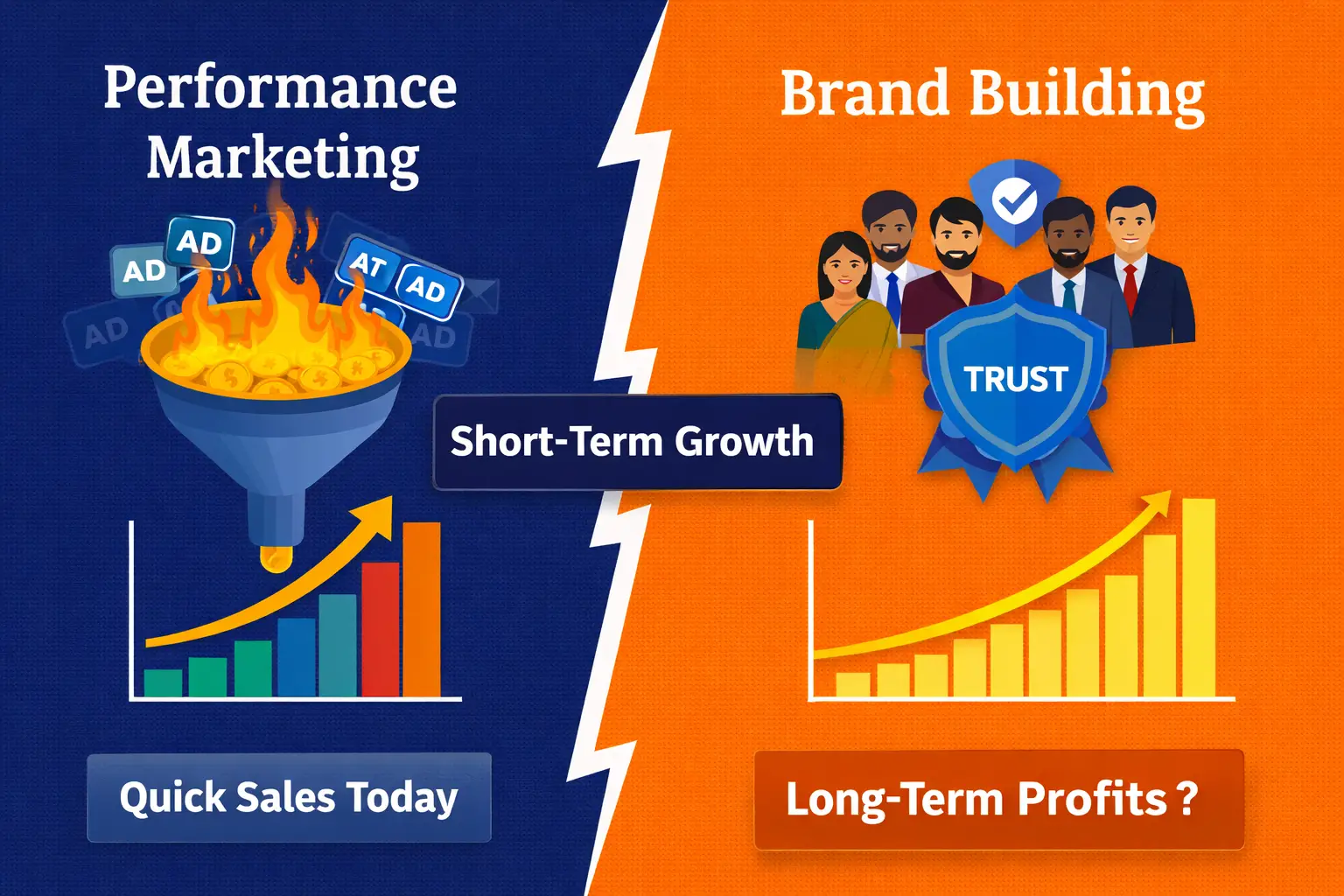
Derived from the seminal research by Binet & Field, the thesis is simple, for optimal, long-term profitable growth, a brand should allocate 60% of its budget to Brand Building and 40% to Performance Activation.
Brand Building (60%): Creates “Mental Availability.” It influences the consumer long before they need the product. It’s emotional, broad, and slow acting.
Performance (40%): Creates “Physical Availability.” It captures the demand that the brand/need already created. It’s rational, targeted, and immediate.
The 60:40 split isn’t arbitrary. It’s derived from decades of research by Les Binet and Peter Field analysing over 1,000 case studies in the IPA Effectiveness Databank.
Does It Apply to India?
But does it apply to India? Let me show you why it’s even MORE critical in the Indian context:
- Extreme Market Fragmentation: India has over 800 D2C brands competing for attention across dozens of categories. In saturated markets, brand recall becomes the primary differentiator.
- Trust Deficit in Digital Commerce: Indian consumers, particularly in Tier 2/3 cities, require higher trust thresholds before purchasing from unfamiliar brands online. Brand building creates that trust faster than performance ads.
- WhatsApp and Community Commerce Dynamics: India’s unique preference for WhatsApp-based commerce and community-driven purchasing (reseller networks, community recommendations, wom) means brand equity compounds faster here than markets where transactions are purely individualistic.
- The Time-Value Equation: Here’s the critical insight that performance-obsessed marketers miss. Performance marketing generates results this quarter. Brand building generates compounding results over quarters. Performance marketing tells people how to buy. Brand building tells them why to care.
The Contrarian Truth About Indian Market Conditions
Every conversation about reducing performance marketing in India gets the same pushback.
Objection 1: India is Different
1.But India is different! Tier 2/3 cities are just discovering online shopping. We need performance marketing to capture this growth.
This is exactly backwards. Tier 2/3 consumers are MORE influenced by brand trust, not less. They have HIGHER skepticism of unknown brands, not lower. They rely MORE on community recommendations and brand familiarity, not less.
The brands winning in tier 2/3 aren’t those with the highest performance marketing budgets. They are brands like Meesho (built on trust and community), brands like Patanjali (built on brand narrative and trust), brands like Boat (built on brand coolness and aspiration). Performance marketing can extract demand from aware audiences. It cannot create demand in skeptical audiences.
Objection 2: Investors Want Growth Now
2.But our investors want growth NOW. Brand building takes too long!
Let me show you what “too long” actually means:
- Brand search volume typically shows measurable improvement in 3-4 months
- Organic traffic impact visible in 4-6 months
- Direct traffic impact visible in 6-9 months
- CAC reduction visible in 6-12 months
- Full compounding effect visible in 12-18 months
Compare this to the alternative i.e. spending 18 months scaling performance marketing, achieving 2x revenue growth, but destroying unit economics so badly that the business becomes unfundable. Which is actually slower, building a brand that generates compounding returns, or rebuilding unit economics after performance marketing costs have made your business unprofitable?
Objection 3: Brand Building Can Wait
3. We’ll do brand building once we achieve scale. Right now, we need revenue.
This is like saying “I will invest in my health once I am successful. Right now, I need to work 18 hours a day.”
By the time you “achieve scale” on performance marketing alone, you must have:
- Trained your customers to expect discounts
- Built zero brand loyalty
- Created dependency on expensive paid channels
- Compressed margins to unsustainable levels
There’s no “later” for brand building. The best time to start was few years ago. The second-best time is today.
Conclusion / Discussion
What’s your current performance vs. brand split? Have you seen CAC spiralling in your category? Contact us for a strategy call to discuss the real numbers, this is where the honest conversation happens.