Google Just Killed Old-School SEO at I/O 2026 – Here’s Exactly What to Do Next
This article is based on primary source material from Google’s official I/O 2026 keynote (May 19, 2026), Elizabeth Reid’s (VP, Google Search) official blog post, Google’s AI Search Optimisation Guide published May 15, 2026, and analysis from SEJ, PPC Land, Semrush, Launchcodex, and Coalition Technologies.
Let’s be blunt: if you are still doing SEO the way you were doing it two years ago, chasing keyword rankings, publishing thin how-to articles, and calling it a day — Google just served you an eviction notice.
On May 19, 2026, at the Shoreline Amphitheatre in Mountain View, California, Google’s VP of Search Elizabeth Reid stood on stage and said something that should send chills down every digital marketer’s spine: “We are entering the next chapter of Google Search where incredible AI features aren’t just in Search. Google Search is AI Search, through and through.”
This is not an incremental update. This is not another core algorithm shuffle that you ride out for a few weeks. This is a structural redesign of the world’s most-used product touching how search understands queries, how it presents answers, how it discovers and monitors information on your behalf, and how it completes purchases without you ever clicking on a website.
In this guide, we break down every major announcement from Google I/O 2026 that impacts SEO from the rebuilt search box to autonomous AI agents, from the Universal Cart to generative UI and we give you a clear, actionable playbook to not just survive but dominate in this new era.
The Numbers That Define Google Search in 2026
What Happened at Google I/O 2026? The Biggest Search Overhaul in 25 Years
Before we talk strategy, you need to understand what Google actually announced and why it is fundamentally different from anything that came before it.
Gemini 3.5 Flash outperforms the previous Gemini 3.1 Pro on most benchmarks. A Flash-tier model beating a Pro-tier model is the core technical claim Google made at I/O 2026, and it is the engine behind every Search change announced.
AI Mode Powers Up with Gemini 3.5 Flash
The single most immediate change is the model powering AI Mode. Google replaced its previous AI backbone with Gemini 3.5 Flash a model that, according to Sundar Pichai at the I/O keynote, is four times faster than most frontier AI models and twelve times faster when running on Google’s custom Antigravity infrastructure.
Why does speed matter for SEO? Because faster inference is what makes background AI agents technically feasible at scale. An agent that monitors the web continuously for a user can now process, synthesise, and deliver results in seconds, not minutes. Your content needs to be readable, parseable, and citable in that same instant.
The Search Box Is Completely Rebuilt
Google called it the biggest upgrade to the Search box in over 25 years. The new interface is not a cosmetic update. It is a functional reinvention. The box now:
- Expands dynamically to accommodate longer, conversational queries
- Accepts text, images, files, videos, and Chrome tabs as inputs from a single field
- Offers AI-powered suggestions that anticipate your full intent — not just the next word
- Allows follow-up questions directly within an AI Overview, pulling users into a back-and-forth AI Mode conversation without leaving the page
- Accumulates conversational context across turns, making results more relevant the longer you search
What this means for SEO: Short, keyword-stuffed queries are being replaced by long, contextual prompts. Your content must match the language of intent-rich conversation, not just isolated keyword strings.
Information Agents: Google Now Searches for You 24/7
This is the announcement that most SEOs were not expecting — and it changes the game the most.
Information agents are persistent, autonomous AI systems that run inside Google Search and operate continuously without the user needing to submit a new query. According to Elizabeth Reid at the keynote, these agents “operate in the background 24/7” and intelligently scan blogs, news sites, social posts, and real-time finance, shopping, and sports data to monitor for changes related to a user’s specific question.
In practice: a user apartment hunting in Bengaluru describes their requirements once. The agent scans listings continuously and notifies them when a match appears. A sneaker enthusiast gets an alert the moment their favourite athlete announces a collab. A procurement manager gets an update the instant a supplier changes pricing.
Information agents launch first for Google AI Pro and Ultra subscribers in the USA in Summer 2026. Indian marketers should prepare now — the rollout will follow the same pattern as AI Mode: US first, then global within months.
SEO implication: As SEO consultant Marie Haynes noted in her post-I/O analysis, ‘Currently, SEO is optimised for a single snapshot in time a user typing a query right now. With background agents, you are optimising for continuous tracking.’ Your content must stay current, your pricing must be accurate, and your product data must be machine-readable.
Generative UI: Search Results That Build Themselves
Powered by Gemini 3.5 Flash’s speed advantage, Google can now generate a custom interactive interface in direct response to a query. Instead of returning ten blue links, Search might generate a comparison table, a calculator, a compatibility checker, or an interactive decision tool built on the fly, tailored to your exact question.
This has profound implications. Whether your brand or product appears inside a generative UI response depends on factors Google has not fully disclosed but early signals point to structured data quality, content authority, and entity consistency as the key signals.
Notably: Google’s new Lighthouse tool now includes agent monitoring capabilities. One signal it checks is the presence of an LLMs.txt file on your domain a machine-readable file that tells AI agents how to interpret and use your website.
Universal Cart & Agentic Commerce: Google Becomes Your Store
Perhaps the most commercially significant announcement for e-commerce businesses: Google introduced the Universal Cart an AI-powered cross-merchant shopping cart that works across Google Search, the Gemini app, YouTube, and Gmail.
The Universal Cart runs on Google’s Gemini models and integrates natively with Google Wallet. Once an item enters the cart, it continuously monitors price drops, deals, and availability. More significantly, Google also unveiled two accompanying protocols:
- UCP (Universal Commerce Protocol) — a shared infrastructure layer co-developed with Shopify, already endorsed by Amazon, Meta, Microsoft, Salesforce, and Stripe. It enables smooth cross-merchant checkout while allowing brands to remain the merchant of record.
- AP2 (Agent Payments Protocol) — allows AI agents to make secure purchases on a user’s behalf within user-defined guardrails, including specific brands, product criteria, and spending limits. The agent only buys when all conditions are met.
UCP-powered checkout is expanding to Canada and Australia now, and the UK later in 2026. India is not yet on the announced roadmap, but given India’s position as Google’s largest user base, expect movement in 2027. Prepare now.
Why Old SEO Is Breaking — And What’s Replacing It
Understanding what changed at I/O 2026 is the first step. Understanding why your existing SEO playbook is no longer sufficient is the more important one.
The Death of the Keyword: AI Mode Queries Are 3x Longer
Queries in AI Mode run on average three times as long as conventional search queries, and total AI Mode query volume has more than doubled every quarter since launch. People are no longer typing ‘best laptop under 50000.’ They are asking ‘What is the best laptop under 50,000 rupees for a graphic designer who works in Bangalore and travels frequently, needs at least 16GB RAM, and will primarily use Adobe tools?’
Traditional keyword density optimisation cannot serve a query like that. What serves it is structured, contextual content that answers specific use-case scenarios with enough detail that the AI can extract the right answer for the right user.
Citations Are the New Rankings: Why Being ‘Named’ Beats Being #1
Research published alongside the I/O announcements shows that brands cited inside AI Overviews earn 35% more organic clicks than competitors who are not cited even when those competitors rank at position one.
The goal is no longer to rank. The goal is to be named. Google’s AI must know who you are, what you do, why you are trustworthy, and what specific answers your content provides. Entity clarity and content authority are the new domain authority.
Two Separate AI Surfaces — AI Mode vs AI Overviews
A critical nuance most SEOs are missing: only about 14% of URLs appearing in AI Mode citations overlap with AI Overview citations. These are completely separate optimisation targets. A page that gets cited in AI Overviews will not automatically get cited in AI Mode responses — and vice versa. You need to audit and optimise for both independently.
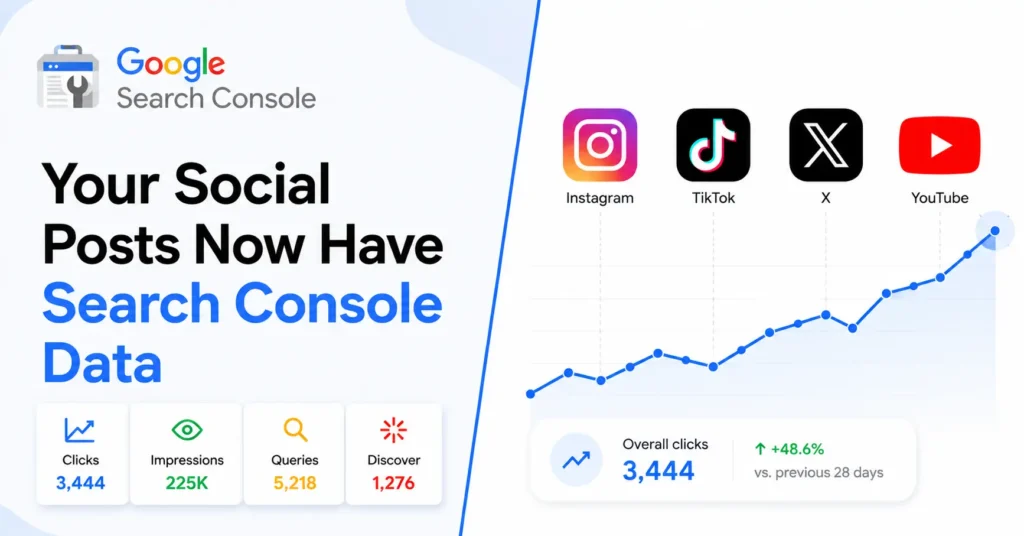
Check your Google Search Console. Filter your performance report by query type. If informational queries are losing clicks while transactional queries are holding steady — that is the AI Overview cannibalization signature. 30-40% traffic drops on informational content are now common.
The New SEO Playbook: General SEO in the AI Era
Run Your AI Citation Audit First
Before you change anything on your website, you need to know where you stand right now. Run your top 20 most valuable queries — the ones that drive actual revenue intent through AI Mode, Google’s AI Overviews, Gemini, Perplexity, ChatGPT, and Claude. Map where your brand appears. Map where competitors appear. This becomes your baseline citation share the single most important new metric in SEO for 2026.
Entity Signals and Brand Authority Now Drive Visibility
Google’s AI systems identify and validate brands through entity signals: consistent brand name usage across the web, knowledge graph presence, third-party review signals, and authoritative mentions. For Indian businesses, this means ensuring your brand has a complete and accurate Google Business Profile, consistent NAP (Name, Address, Phone) data across directories, verified reviews on credible platforms, and a clear digital paper trail that establishes who you are and what you specialise in.
Voice and Conversational Query Optimisation
Voice interactions are becoming more important across Google Search, Gemini, Gmail, Docs, and other Workspace tools. Optimise your content to answer questions the way a person asks them in conversation, not the way they would type a query. Structure headings as questions. Write answers as concise paragraphs of 40-80 words. Map your buyer journey to conversational prompts ‘best X for Y person’ patterns are high-value AI Mode query templates.
Technical SEO Has Changed: What Indian Developers Need to Know
Google’s official AI Search Optimisation Guide, published on May 15, 2026, confirms that browser agents access websites by analysing screenshots, inspecting the DOM structure, and interpreting the accessibility tree. Technical SEO is now about serving both Googlebot and AI agents simultaneously.
Structured Data Is Now an Agent Signal, Not Just a Rich Snippet Tool
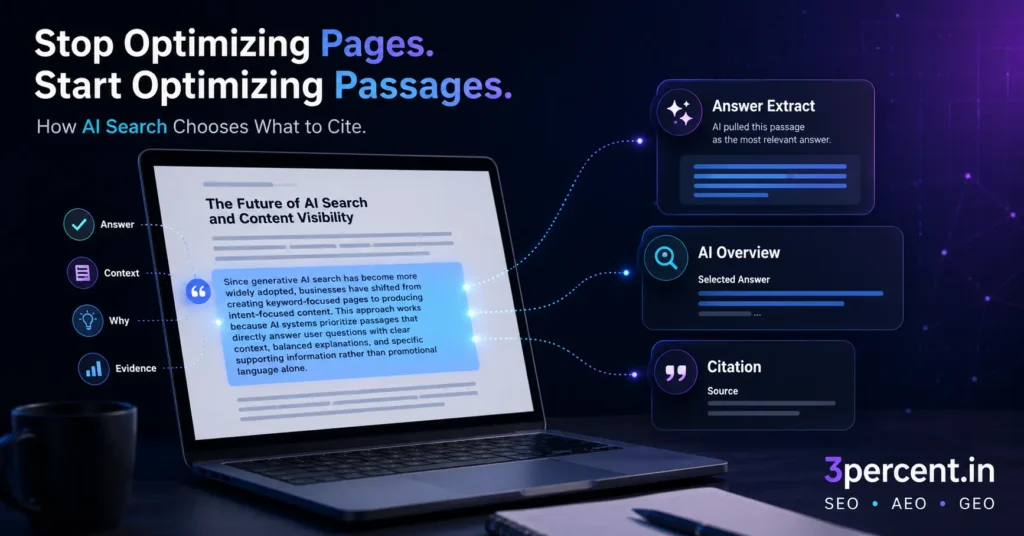
Schema markup creates structured signals that help Google parse what a page is, who produced it, and what claims it makes — all inputs to the AI source-selection process. For 2026, every serious website should have:
- Product schema with complete Offer, AggregateRating, and availability attributes
- FAQPage schema on product and category pages, these feed directly into AI-generated Q&A outputs
- Organisation and SiteLinksSearchBox schema at root level for brand entity validation
- BreadcrumbList schema across all page types for navigational clarity
- ItemList schema on collection and category pages so AI can parse your product catalogue as a structured set.
LLMs.txt — The New robots.txt for the AI Age
Google’s Lighthouse tool now checks for the presence of an LLMs.txt file as part of agent monitoring. This is a plain-text file, hosted at yoursite.com/llms.txt, that describes your website’s key pages, products, and use cases in language AI agents can parse. Think of it as a briefing document you leave for the AI that will read and interpret your site on a user’s behalf.
LLMs.txt is not yet a confirmed direct ranking factor, but it is a forward-compatibility signal. Implementing it today costs nothing and positions you ahead of competitors who will scramble to add it once it becomes a hard requirement.
Core Web Vitals Matter Even More When AI Agents Are Browsing
Gemini 3.5 Flash processes information twelve times faster than previous models on Google’s Antigravity infrastructure. When an AI agent browses your site to extract product data, pricing, or content a slow page is a signal of poor quality. Audit your LCP (Largest Contentful Paint), INP (Interaction to Next Paint), and CLS (Cumulative Layout Shift) in Chrome’s Core Web Vitals report. Target sub-2 second LCP on mobile for product and category pages. Ensure your product pages render correctly without JavaScript, AI agents need server-side rendered content.
Content Strategy: Writing for Humans AND AI Agents
The most dangerous misconception circulating in SEO communities right now is that you should ‘write for AI.’ Danny Sullivan, Google’s Search Liaison, explicitly advised against breaking content into small chunks designed for AI consumption. Google’s systems parse full pages and extract relevant passages. Write for humans. Structure for AI extraction.
Structure Content for Direct-Answer Extraction
AI systems are looking for content that can be extracted as a direct answer to a specific question. This means:
- Open every section with a direct-answer paragraph of 40-80 words — the answer first, the context second
- Use H2 and H3 headings that mirror how a human would ask a question conversationally
- Build comparison tables directly into product and category pages — AI systems use these for synthesis
- Include ‘who this is for’ and ‘who this is not for’ sections — these are high-value AI extraction targets
- Surface all key specifications in HTML tables, never in images or PDFs that agents cannot parse.
Content structured for direct-answer extraction, entity consistency, and clear comparative claims is more likely to be surfaced and synthesised accurately by AI systems. This is confirmed in Google’s own May 2026 optimisation guide.
Build a Proprietary Content Moat No AI Can Replicate
Here is the uncomfortable truth: generative UI can replace informational content at scale. Google can generate a comparison table or a how-to guide on the fly without ever visiting your website. What it cannot generate is your original research, your community’s experience, your proprietary data, and your brand’s unique perspective.
- Commission original research: surveys of your customer base, purchase trend analyses, industry-specific data studies
- Build verified buyer Q&A sections — community-generated trust signals AI cannot fabricate
- Develop interactive tools: size guides, compatibility checkers, ROI calculators, product quizzes
- Gate premium tool features behind login or email capture — creating content experiences generative UI cannot replicate
GEO: Generative Engine Optimisation Is the New SEO Discipline
GEO — Generative Engine Optimisation, is the practice of optimising your brand’s presence and representation across AI-generated search experiences. Google’s own May 2026 guide confirms that GEO and traditional SEO are not separate disciplines: strong foundational SEO, combined with content only your team can produce, is what earns visibility across every AI surface.
For Indian businesses, GEO means:
- Weekly monitoring of how your brand is represented in AI Mode responses for target queries
- Immediate content updates when AI Mode surfaces outdated product information or incorrect pricing
- Active management of third-party review profiles that AI systems use for brand validation
- Consistent entity naming — your brand name must appear identically across your site, GMB, social profiles, and all third-party mentions.
What This Means for Indian Businesses: An India-First Analysis
Personal Intelligence Now in 200 Countries — Including India
One of the most significant announcements for Indian marketers: Personal Intelligence Google’s feature that personalises AI Mode results using a user’s Gmail, Google Photos, and other personal data has expanded to nearly 200 countries and 98 languages, with no subscription required.
This means Indian users searching on Google will now receive AI-personalised search results informed by their personal email history, location, calendar, and purchase behaviour. For brands, this has two major implications:
- Generic brand-level SEO will yield less. Personalised signals past purchases, email interactions, location proximity — will increasingly determine which brand gets cited in a personalised AI response.
- Customer retention becomes an SEO signal. Users who have bought from you before, emailed your support team, or visited your store are more likely to receive results featuring your brand in AI-personalised responses. Post-purchase engagement is now part of your search visibility strategy.
E-commerce in India: Prepare for UCP and Agentic Commerce
Universal Cart and UCP are launching in the USA first, then Canada, Australia, and the UK. India is not on the current roadmap — but with India being Google’s largest user base by volume, and with Flipkart, Meesho, Myntra, and other Indian platforms already integrated into Google’s Shopping Graph, UCP adoption in India is a matter of when, not if.
Indian e-commerce teams should act now:
- Audit your Google Merchant Center product feeds for completeness Google analyses 47 product attributes per SKU to determine Shopping Graph eligibility
- Ensure all product data includes complete GTINs, brand, colour, size, material, and condition attributes
- Connect Merchant Center to live inventory via the Content API for real-time price and availability accuracy
- Monitor the UCP Technology Council announcements — Amazon, Meta, Microsoft, Salesforce, and Stripe have already joined, and Indian platform adoption will follow.
Brands using professional product photography and consistent image formatting have reported better visibility in AI-generated shopping placements. Products with complete structured data see 30% higher click-through rates in AI Overview placements. This is not optional — it is infrastructure.
Your 90-Day Action Plan: Step by Step
Stop reading and start doing. Here is your prioritised action plan, sequenced for maximum impact.
DAYS 0 – 30: Audit, Fix Foundations, Establish Baselines
| Action | Why It Matters |
|---|---|
| Run AI citation audit | Map brand visibility across AI Mode, Gemini, Perplexity, ChatGPT, Claude establish citation share baseline |
| Audit Google Merchant Center feeds | Fix missing GTINs, brand, colour, size, material Google analyses 47 attributes. Every gap = less visibility |
| Full structured data audit | Validate Product, Offer, AggregateRating, FAQPage, BreadcrumbList schema. Fix all Search Console Rich Results errors |
| Add LLMs.txt to your domain | Create /llms.txt describing key pages, products, use cases. Update robots.txt to not block GPTBot or Google-Extended |
| Segment GSC by query intent | Split informational vs transactional vs brand queries. Set weekly CTR alerts on money pages |
| Enable GA4 AI channel group | Separate traffic from AI chatbot referrals. Build custom AI traffic vs organic revenue report |
DAYS 30 – 60: Optimise Content, Build Authority
| Action | Why It Matters |
|---|---|
| Audit top 20 pages for direct-answer structure | Rewrite intros as 40-80 word direct answers. Add comparison tables, use-case scenarios, specs in HTML |
| Build decision-ready content | Create ‘Product A vs B’ guides, ‘best X for Y person’ buyer guides, and FAQ sections under 60 words per answer |
| Strengthen entity signals | Complete Google Knowledge Panel, build consistent brand presence across directories and review platforms |
| Fix Core Web Vitals on product pages | Target sub-2s LCP on mobile. Fix INP issues on filtering and cart. Ensure SSR for agent crawlability |
| Audit product images for AI Overviews | Add descriptive alt text, consistent lifestyle photography, implement image sitemaps |
| Start proprietary content production | Commission original research, set up verified buyer Q&A, plan interactive tool development |
DAYS 60 – 90: Scale, Future-Proof, Measure
| Action | Why It Matters |
|---|---|
| Build real-time product feed infrastructure | Connect Merchant Center to live inventory via Content API. Add GTIN, MPN identifiers across all SKUs |
| Test agent crawlability | Verify checkout and product pages work without JavaScript. Test DOM accessibility tree completeness |
| Track citation share month-over-month | Compare AI surface visibility vs baseline. Identify which content changes drove citation gains |
| Develop GEO monitoring workflow | Weekly AI surface audits for brand representation. Immediate content response process for AI misinformation |
| Prepare for UCP integration | Monitor UCP Tech Council developments. Brief your tech team on the Universal Commerce Protocol |
| Build AI SEO monthly report | Citation share + AI-sourced sessions + Merchant Center feed health + Core Web Vitals = your new KPI stack |
FAQ: Google I/O 2026 and SEO — Your Questions Answered
Answers written to serve as schema-eligible FAQPage content. Use these on your blog page with FAQPage structured data markup.
What is the biggest SEO change from Google I/O 2026?
The introduction of information agents autonomous AI systems that monitor the web continuously on a user’s behalf represents the most structural change. Unlike traditional search, where a user types a query and receives results, information agents run 24/7 and send synthesised updates when relevant information changes. This means your content, pricing, and product data must stay current at all times, not just at the moment of indexing.
Is traditional keyword SEO dead after Google I/O 2026?
Not dead, but significantly diminished in isolation. Keywords are still the foundation of how Google’s index works. However, optimising only for keywords while ignoring AI citation signals, structured data quality, entity authority, and content depth is now insufficient. Think of keywords as the entry point and AI citation as the destination. You need both.
What is AI Mode and how is it different from normal Google Search?
AI Mode is Google’s conversational search experience powered by Gemini. Unlike standard search that returns a list of links, AI Mode synthesises information from multiple sources, supports multi-turn conversations, and provides direct answers with supporting citations. It has passed one billion monthly users and processes queries that are on average three times longer than traditional search queries.
What is LLMs.txt and does my website need it?
LLMs.txt is a plain-text file hosted at your domain root (yoursite.com/llms.txt) that describes your website’s key pages, products, and use cases in a format AI agents can easily parse. Google’s Lighthouse tool now checks for its presence as part of agent monitoring. While not yet a confirmed ranking factor, it is a forward-compatibility signal. Indian websites should implement it now at no cost.
How does the Universal Cart affect Indian e-commerce businesses?
Universal Cart is launching in the USA first, with Canada, Australia, and the UK following. India is not on the current announced roadmap. However, Indian e-commerce businesses should prepare now by ensuring complete Google Merchant Center product feeds, implementing UCP-compatible structured data, and monitoring the Universal Commerce Protocol’s expansion. With India being Google’s largest user base, UCP adoption is expected to follow within 12-24 months of US launch.
What does ‘citation share’ mean and how do I track it?
Citation share is the percentage of target queries for which your brand is named or referenced inside AI-generated search responses AI Mode, AI Overviews, or other AI surfaces. Unlike traditional rank tracking, citation share measures AI surface visibility rather than position in a list of links. Track it using tools like Profound, Otterly, or Semrush’s AI Visibility Toolkit. GA4’s new AI Assistant channel group tracks traffic arriving from AI chatbot referrals.
Will AI Overviews replace my website traffic entirely?
For informational queries, traffic declines of 30-40% are already documented. AI Overviews appear on 48% of all searches, and many users get their answer without clicking. However, for transactional, high-intent, and brand-specific queries, clicks remain strong users and their agents still need to buy, book, and sign up. The strategy is to let informational content serve as AI citation bait while driving conversion traffic through transactional content, product pages, and brand authority.
What is GEO (Generative Engine Optimisation) and how does it differ from SEO?
GEO is the practice of optimising your brand’s representation within AI-generated responses across all AI surfaces not just Google. While SEO focuses on ranking position in traditional search results, GEO focuses on citation quality, entity accuracy, and brand representation inside AI-synthesised answers. Google’s own May 2026 guide confirms that strong SEO and strong GEO are complementary, not competing the brands winning in both areas share the same foundational content and technical quality.
Does Google IO 2026 affect local SEO in India?
Yes, significantly. Agentic booking capabilities now cover local experiences and services. A user can describe their requirements ‘find a private meeting room for 10 people near Koramangala, Bengaluru, available this Saturday, with projector and parking‘ and an agent will find and shortlist options. Local businesses need accurate Google Business Profiles, real-time availability data, strong reviews, and clean structured data to appear in these agent-shortlisted results.
The Bottom Line
Your website used to be a destination. In 2026, it is infrastructure for AI agents.
Every missing product attribute, every outdated price, every page that fails to load
without JavaScript, each one is a signal that tells Google’s AI to prefer a competitor over you.
The brands that will dominate in the next 18 months are not the ones who panic and overhaul everything.
They are the ones who fix their foundations, structure their content for AI extraction,
build proprietary signals no AI can generate, and measure citation share alongside traditional rankings.
Start your 90-day plan today. Not next quarter. Today.
Disclaimer: SEO is a rapidly evolving field. Recommendations in this article are based on information available at the time of publication (May 2026). Google's AI features and protocols continue to evolve. Always verify current best practices against the latest official Google documentation.
Sources & References
All claims in this article are sourced from primary sources and authoritative SEO publications. Last verified: May 22, 2026.
- Elizabeth Reid (VP, Google Search) — ‘A New Era for AI Search’, Google Blog, May 19, 2026 — blog.google/products-and-platforms/products/search/search-io-2026
- Google I/O 2026 — ‘100 Things We Announced at Google I/O 2026’, Google Blog, May 19, 2026 — blog.google/innovation-and-ai/technology/ai/google-io-2026-all-our-announcements
- Google Shopping Blog — ‘Universal Cart & UCP Expansion’, Google Blog, May 19, 2026 — blog.google/products-and-platforms/products/shopping/google-shopping-cart
- Google — ‘AI Search Optimisation Guide’, May 15, 2026 — (referenced across multiple authoritative SEO publications)
- Marie Haynes — Google I/O 2026 SEO Analysis Video, YouTube, May 20, 2026
- Coalition Technologies — ‘Google I/O 2026 SEO: Search Takeaways’, coalitiontechnologies.com, May 2026
- PPC Land / Luis Rijo — ‘Google I/O 2026: The Search Changes SEOs Did Not Expect’, ppc.land, May 21, 2026